

Enriched and fortified do not always mean the same thing. On U.S. bread labels, enriched flour usually means certain B vitamins and iron were added to refined flour in amounts defined by federal standards. Fortified is broader: it generally means nutrients were added to a food, whether or not they were originally present in meaningful amounts. Neither word tells you whether a bread is low in carbohydrates, high in fiber, or a good fit for your individual needs.
This distinction matters when comparing low-carb bread. A loaf can use enriched wheat flour, add extra vitamins and minerals, use whole grains without the word “enriched,” or rely on fiber and protein ingredients that change the carbohydrate profile. Read the ingredient list and Nutrition Facts panel together instead of treating either term as a health verdict.
Enriched vs. fortified: the quick difference
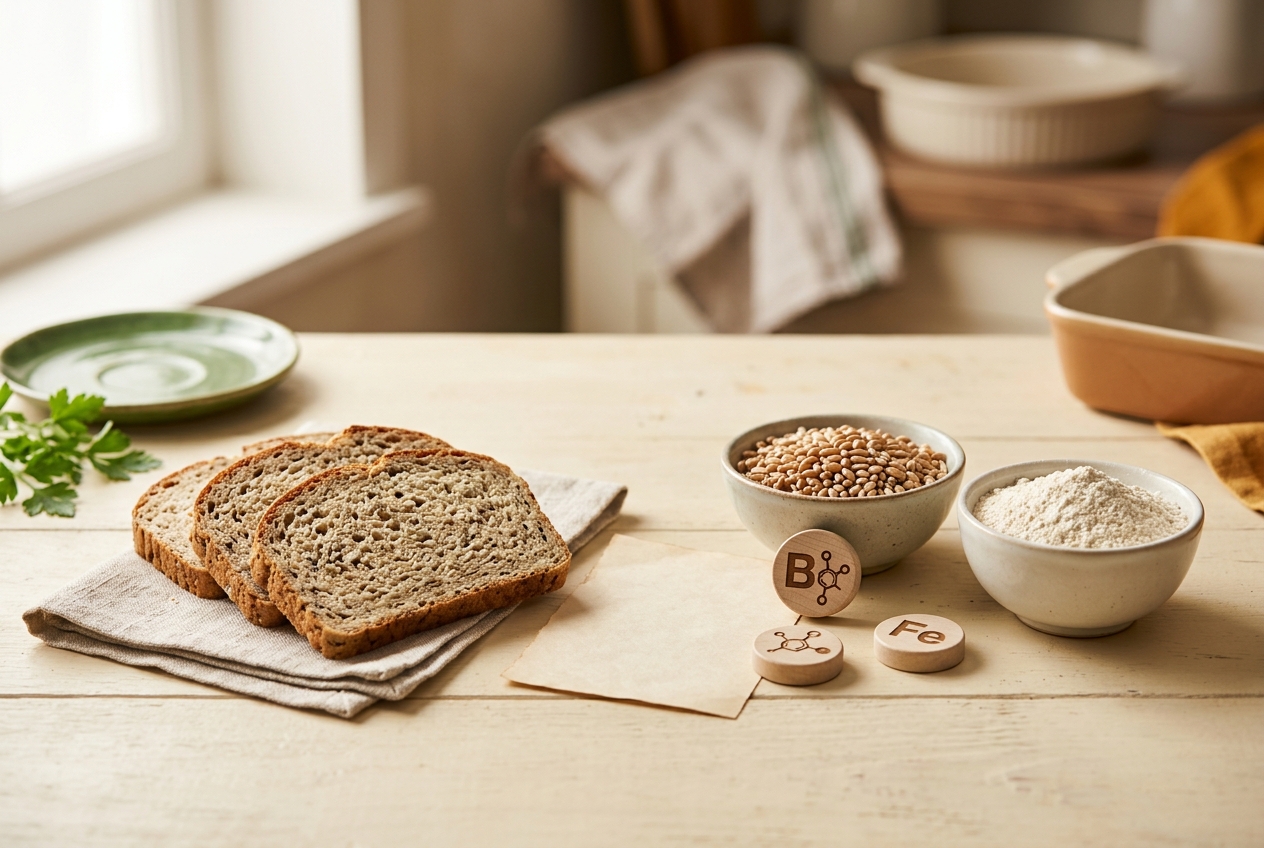
Enrichment generally adds specified nutrients to a refined food. For U.S. enriched flour, federal standards name thiamin, riboflavin, niacin, folic acid, and iron.
Fortification is the broader addition of nutrients to food. FDA policy addresses when and how manufacturers may add essential nutrients and discourages indiscriminate addition.
In casual conversation, people sometimes use the two words interchangeably. On standardized U.S. foods such as enriched flour, however, “enriched” has a specific regulatory meaning.
What “enriched flour” means on a bread label
Refining wheat removes the bran and germ, leaving mostly the endosperm. That process changes the flour’s natural nutrient profile. Enrichment adds selected nutrients to refined flour according to a standard.
Under 21 CFR 137.165, flour labeled “enriched flour” must contain specified amounts of:
- Thiamin (vitamin B1)
- Riboflavin (vitamin B2)
- Niacin (vitamin B3)
- Folic acid
- Iron
The regulation also permits optional calcium and vitamin D under defined conditions. The exact regulatory amounts are expressed per pound of flour; the amount that reaches one slice of bread depends on the recipe, slice size, and other ingredients.
On an ingredient list, you may see wording such as “enriched wheat flour” followed by the added nutrients in parentheses. The order and wording can vary. Read the complete parenthetical list instead of assuming every flour blend is identical.
What “fortified” means
Fortification covers the addition of nutrients to foods more generally. A manufacturer might add a nutrient that was not present in a meaningful amount before processing, increase an existing nutrient, or use fortification to address a public-health need.
The FDA’s fortification-policy guidance explains that the agency discourages adding nutrients indiscriminately. Some standardized foods have required nutrient levels if they use a defined name, while fortification of many other conventional foods is voluntary.
For example, the NIH Office of Dietary Supplements notes that folic acid has been required in enriched cereal-grain products in the United States since 1998. This program made breads, cereals, flour, pasta, rice, and related foods important sources of folic acid.
Does enriched or fortified mean low-carb?
No. Enrichment and fortification describe added micronutrients, not the total carbohydrate content of a serving. A bread can be enriched and relatively high in carbohydrates, or enriched and formulated with added fiber to reduce its stated net-carbohydrate count.
To evaluate a low-carb bread, check:
- Serving size. Confirm whether the label uses one slice, two slices, or a gram weight.
- Total carbohydrate. This is the starting point for comparing products.
- Dietary fiber. Note the amount and inspect which fiber ingredients appear in the ingredient list.
- Sugar alcohols. If present, identify the specific type rather than subtracting them automatically.
- Protein, sodium, and calories. These can differ substantially even when two products advertise similar net carbs.
Our guide to reading a nutrition label for net carbs explains how to make a consistent comparison. You can also use the LessCarby Net Carb Calculator.
Why low-carb breads may still use enriched wheat flour
Not every low-carb bread is built the same way. Some formulas combine enriched wheat flour with resistant starches, isolated fibers, wheat gluten, seeds, or other ingredients. Others avoid conventional flour and use almond flour, flaxseed, eggs, or psyllium.
If enriched wheat flour appears near the beginning of the ingredient list, the loaf still may contain significant added fiber or protein. Its position does not reveal the final carbohydrate amount by itself. Conversely, a bread without enriched flour is not automatically lower in carbs or nutritionally superior.
For related ingredient guidance, see our explanations of modified wheat starch, vital wheat gluten, and psyllium husk in low-carb bread.
Enriched flour is not the same as whole-grain flour
Enriched refined flour and whole-grain flour are different ingredients. Whole-grain flour retains the bran, germ, and endosperm in their original proportions. Enriched flour is refined flour with selected nutrients added.
Enrichment does not restore every component removed during refining. For example, it does not automatically recreate the original fiber structure or the full range of compounds present in the bran and germ. That does not make enriched flour inherently “bad,” but it does mean the two terms are not interchangeable.
How to read the ingredient list
Start at the beginning, because ingredients are listed by weight. Then read any parenthetical sub-ingredients.
- “Enriched wheat flour” should be followed by its enrichment ingredients.
- “Whole wheat flour” signals a whole-grain ingredient, though the loaf may also contain refined flour.
- Added fibers may include cellulose, oat fiber, inulin, resistant wheat starch, or psyllium.
- Gluten ingredients matter for people with celiac disease or wheat allergy, regardless of the carb claim.
- Allergen statements should be checked separately; enrichment does not change allergen status.
Formulas can change. When accuracy matters, rely on the package in your hand rather than an old retailer photo or a third-party nutrition database.
Do added vitamins make one low-carb bread better?
Added vitamins and minerals can contribute to nutrient intake, but they are only one part of the decision. A useful comparison also considers fiber tolerance, protein, sodium, allergens, serving size, price, availability, and how the bread fits the rest of your diet.
A fortified loaf is not automatically the best choice, and a bread without added nutrients is not automatically inferior. Look at the amounts on the Nutrition Facts panel. The % Daily Value helps show whether one serving contains a little or a lot of a listed nutrient, but it does not measure overall food quality.
What about folic acid?
Folic acid is the form of folate used in enriched cereal-grain products. The NIH folate fact sheet explains that the United States began requiring folic acid in enriched cereal-grain products in 1998 to reduce the risk of neural-tube defects.
If you are monitoring folate for a medical reason, do not estimate your intake from the word “enriched.” Check the Nutrition Facts panel, review your total diet and supplements, and consult a qualified healthcare professional when needed.
A practical five-step comparison
- Match the serving sizes by grams or slices.
- Compare total carbohydrate and fiber before looking at marketing claims.
- Identify the main flour, starch, fiber, and protein ingredients.
- Check sodium, protein, allergens, and any nutrients important to you.
- Use “enriched” or “fortified” as one label detail, not the final verdict.
The bottom line
On U.S. bread labels, enriched flour follows a defined standard for added thiamin, riboflavin, niacin, folic acid, and iron. Fortification is a wider term for adding nutrients to food. Neither term establishes that a bread is low-carb, whole-grain, or appropriate for diabetes.
For low-carb bread, the most reliable approach is to compare equal serving sizes, read the complete ingredient list, and use the Nutrition Facts panel for total carbohydrate, fiber, protein, sodium, and relevant vitamins and minerals.
Save This Post on Pinterest
Frequently asked questions
Is enriched flour unhealthy?
“Enriched” describes selected nutrients added to refined flour. It does not by itself determine whether a food is healthy or unhealthy. Consider the entire product and your dietary needs.
Is fortified bread the same as whole-grain bread?
No. Fortified bread has added nutrients. Whole-grain bread is defined by the grain ingredients it uses. A product can be both, either one, or neither.
Does enriched flour contain folic acid?
In the United States, flour labeled as enriched must meet standards that include folic acid, along with thiamin, riboflavin, niacin, and iron.
Can enriched bread still be low-carb?
It can, depending on the full recipe and serving size. Verify the total carbohydrate, fiber, and other ingredients on the current label.
Save This Post on Pinterest
Plan Your Week with Our Free Meal Planner
Choose seven days of meals, adjust portions, and download your shopping list. No email signup needed.
Open the Free Planner →
