
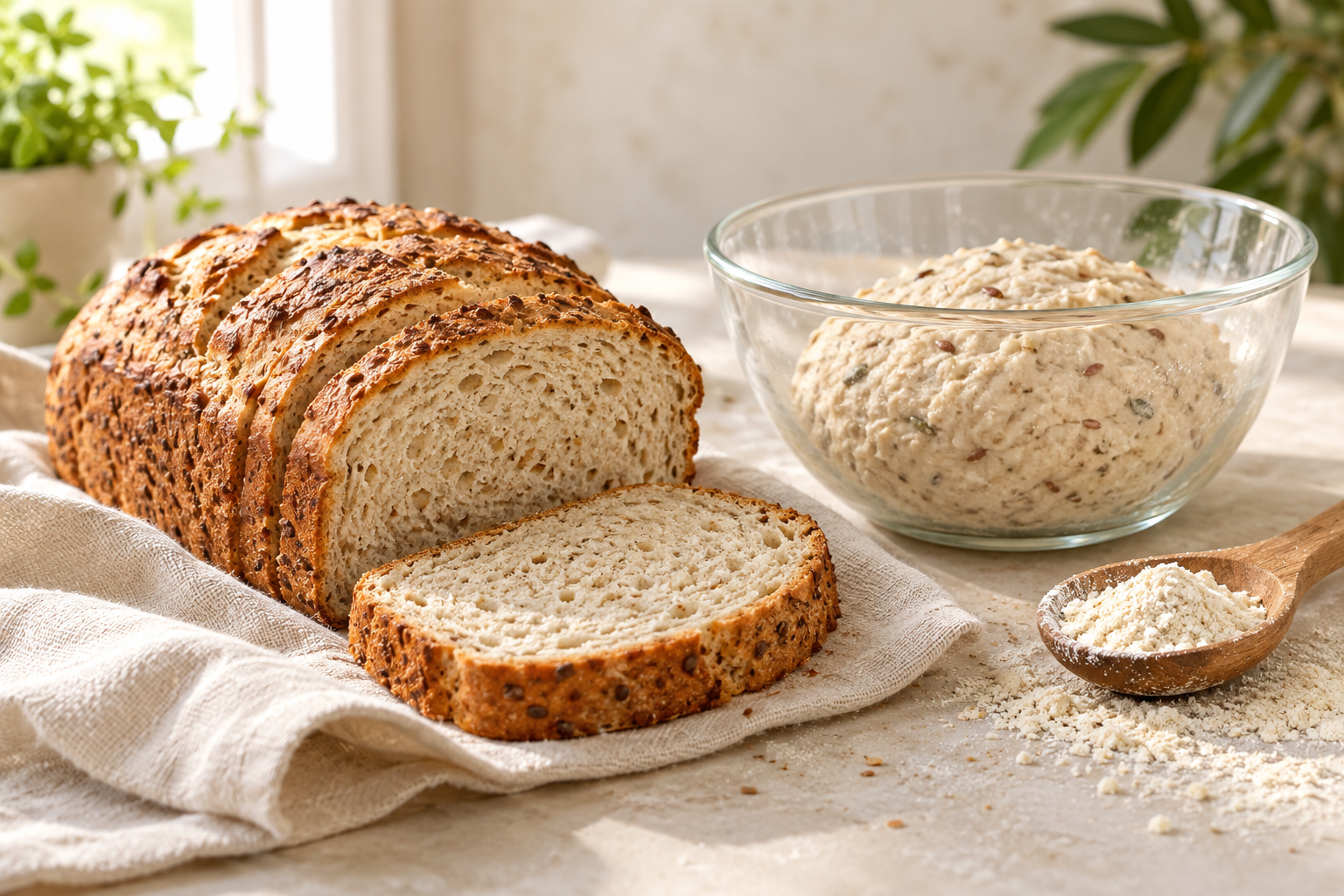
Dough conditioners help bread dough behave more predictably during mixing, shaping and baking. In low-carb bread, they may help a loaf hold its shape or give the finished slice a softer crumb. Their presence alone tells you very little about the bread’s carbohydrate count or whether it suits your needs.
Our advice: read the conditioner name, then judge the whole loaf. Check the serving size, Nutrition Facts, allergens and the ingredients that make up most of the bread. A familiar-looking ingredient list can still belong to a bread that misses your carb goal; a longer list can belong to a useful everyday option.
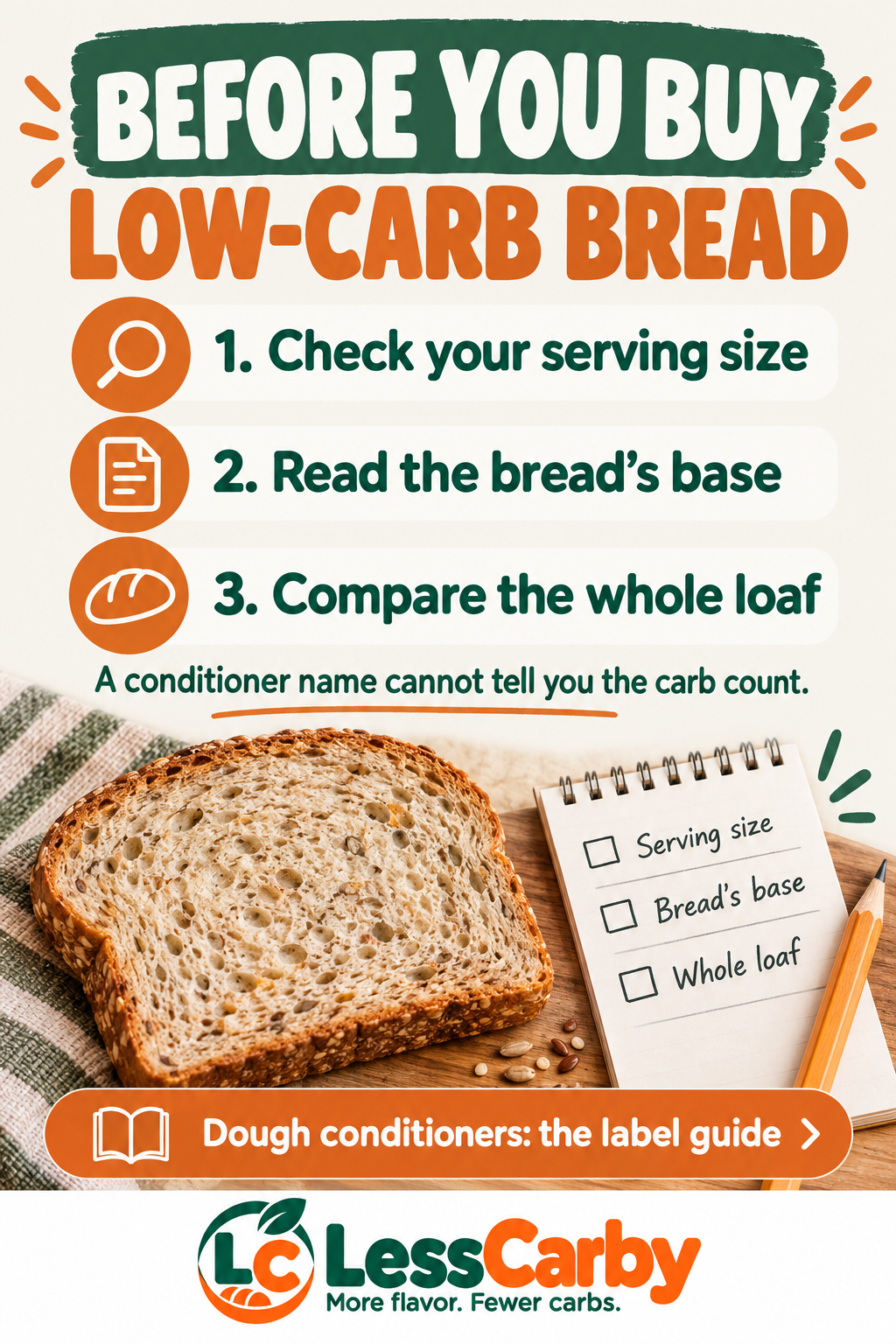
Quick shopping check: Start with the portion you actually eat. Then compare total carbohydrate, fiber and the ingredient list. Treat dough conditioners as information about breadmaking, rather than a shortcut for rating the loaf.
What is a dough conditioner?
“Dough conditioner” and “bread improver” describe ingredients used to change how dough handles or how the baked bread turns out. It is a broad description of a job, rather than the name of one ingredient. Lesaffre describes bread improvers as ingredients that change dough behavior at different stages of breadmaking.
That distinction matters when you turn over a bread bag. Two loaves can both contain conditioners while using different ingredients for different purposes. One might need help during shaping; another might be formulated for a softer sandwich slice. You cannot work backward from the general term to the exact recipe.
Also separate the broad category from the wording printed on your particular package. Read any named ingredients or parenthetical list that follows it. If the label leaves a question unanswered, the manufacturer is the useful next stop.
Why might low-carb bread use them?
Low-carb breads use many different recipes. A wheat-based loaf with added fiber is a different baking project from an almond-flour loaf with eggs. The label should tell you which kind you are buying; the words “low carb” on the front do not.
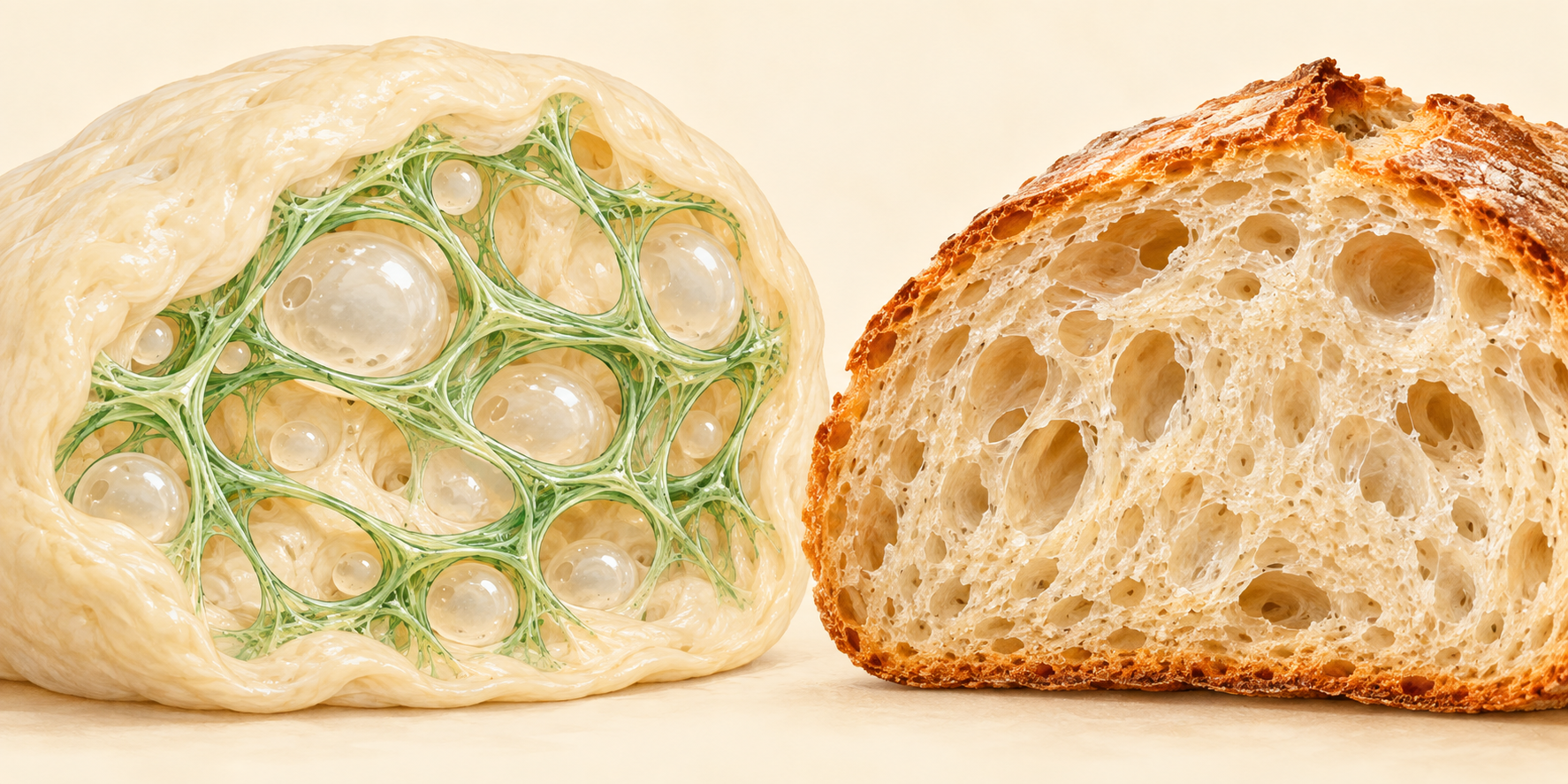
For wheat-based bread, formulation affects the dough structure that holds gas during rising. Lallemand’s technical guide to bread formulas explains that conditioners have different functions and that fiber can interfere with gluten development. This helps explain why a baker might use a dough strengthener in a high-fiber recipe. It does not establish what any individual low-carb brand contains.
For a shopper, the useful question is whether the finished bread does the job you want. A slice for a cold sandwich needs to hold fillings. Toast should stay pleasant after browning. A bread that looks appealing on the label still has to work with your meals. Keep those practical needs alongside your nutrition comparison.
Names you may see on the ingredient list
The following names are examples from breadmaking. They are not a claim that all low-carb breads contain them, or that every ingredient does the same job in every recipe.
Ascorbic acid
Ascorbic acid is vitamin C, but in bread dough it can be used for its breadmaking function. King Arthur Baking discusses its use as an alternative improver when working with unbromated flour. Seeing it on a bread label is not a reason to count the loaf as a meaningful vitamin-C supplement.
DATEM, sodium stearoyl lactylate and mono- and diglycerides
These are names associated with emulsifiers used in baking. Sodium stearoyl lactylate is often shortened to SSL in technical material. Lallemand explains that baking emulsifiers can help dough strength, loaf volume and crumb softness, and that enzyme-based alternatives are also available.
Do not assume these names reveal the source of every ingredient or meet a particular dietary certification. If ingredient origin matters to you, look for the relevant certification and ask the manufacturer about the exact loaf.
Enzymes
Enzymes can also be part of a conditioner system. Their role depends on the particular enzyme and formula. For a closer look at this category, read our guide to enzymes in low-carb bread. An ingredient list that says “enzymes” does not provide a full technical specification.
How to read the label without getting lost
The FDA explains that ingredients are generally listed by descending weight, subject to labeling exemptions. That makes the beginning of the list a useful place to understand the bread’s base. The list still does not give you an exact percentage for each ingredient.
- Find the actual serving. Compare the slice count and serving weight. For a two-slice sandwich, use two slices in your comparison.
- Read the bread’s base. Look for the flour, starch, fiber, protein and other main ingredients. Our protein-isolate guide explains another ingredient category you may encounter.
- Identify the conditioner. Write down the exact unfamiliar name rather than searching only “bread additives.” A specific question gets a more useful answer.
- Read the allergy information. A low-carb claim does not replace the allergen statement or establish that bread is gluten-free.
- Compare the whole product. Include price per usable serving, storage instructions and whether you enjoy eating it.
Do conditioners make bread lower in carbs?
You cannot infer a loaf’s carb count from the presence of a dough conditioner. Use the product’s Nutrition Facts and the serving size instead. If the front of the bag gives a net-carb number, check which ingredients and amounts were subtracted to arrive at it; do not treat the conditioner name as evidence for that calculation.
For example, imagine two bags that each list a conditioner. One label gives nutrition per slice and the other per two slices. Before deciding which fits your lunch, put both on the same portion basis. That simple comparison is more useful than choosing by the number of unfamiliar words.
Should you avoid bread with dough conditioners?
We would not reject a bread solely because it includes a conditioner. We would ask what the ingredient is, whether the loaf meets your dietary requirements, and whether it gives you a bread you want to eat. A preference for a shorter ingredient list is reasonable; it is one selection criterion rather than a complete nutritional verdict.
This guide explains ingredient functions. It does not provide an individualized safety assessment or predict a blood-glucose response. If you need to avoid a specific ingredient for a medical reason, use the current package information and advice appropriate to your condition.
What if you bake low-carb bread at home?
Follow a recipe designed for your flour and method before adding a commercial improver. A wheat-dough additive is not automatically suitable for a loaf made with almond flour or a different structure. More conditioner is not necessarily better: Lallemand’s formula guide notes that dose and process interact.
If your loaf is dense or crumbly, first record the ingredients, measurements, mixing and baking steps you used. Change one thing at a time. That gives you a better basis for deciding whether the recipe needs adjustment than adding an ingredient with no clear purpose.
A better question for your next bread purchase
Ask, “Will this loaf make the sandwich I want, in a portion that fits my needs?” Keep a photo of the label and a short note about how it worked for you. If a conditioner remains a concern, contact the brand with its exact name and the product variant. You will have a specific question to resolve instead of an entire ingredient list to worry about.
Sources checked October 4, 2026. This is a researched ingredient guide; no loaf testing or brand-specific formula analysis is claimed. The illustration shows a general breadmaking concept, not a measured result for a commercial product. No affiliate links are included because a product purchase is not needed to use this guide.
Save This Post on Pinterest
Save the label guide or the shopping checklist for your next bread purchase.
Plan Your Week with Our Free Meal Planner
Choose seven days of meals, adjust portions, and download your shopping list. No email signup needed.
Open the Free Planner →
