
Enzymes in low-carb bread are tools that help bakers control dough strength, rise, softness, browning, and shelf life. They are proteins that speed up specific reactions during mixing, fermentation, and baking. Seeing “enzymes” on an ingredient list does not tell you the bread’s carb count, and it does not automatically make a loaf good or bad. It is one clue about how the formula was built.
Low-carb dough can be difficult to manage because replacing part of the usual wheat flour with fiber, resistant starch, or extra protein changes the way dough holds water and traps gas. Enzymes can help a manufacturer make that dough behave more consistently. The useful question is not simply “Does this bread contain enzymes?” It is “What else is in the formula, what does the Nutrition Facts panel show, and does the loaf fit my needs?”
What is an enzyme?
An enzyme is a protein that speeds up a chemical reaction without being used up in the same way as an ordinary ingredient. Different enzymes act on different materials. In bread dough, one enzyme may work on starch, another on certain parts of fiber, and another on proteins or fats.
The U.S. Food and Drug Administration describes enzymes as substances used to improve food processing and the quality of finished food. Some are added directly to dough, while others occur naturally in flour, malt, or yeast. Heat during baking greatly reduces or stops the activity of many baking enzymes, although the details depend on the enzyme and the process.
Why low-carb bread can need extra help
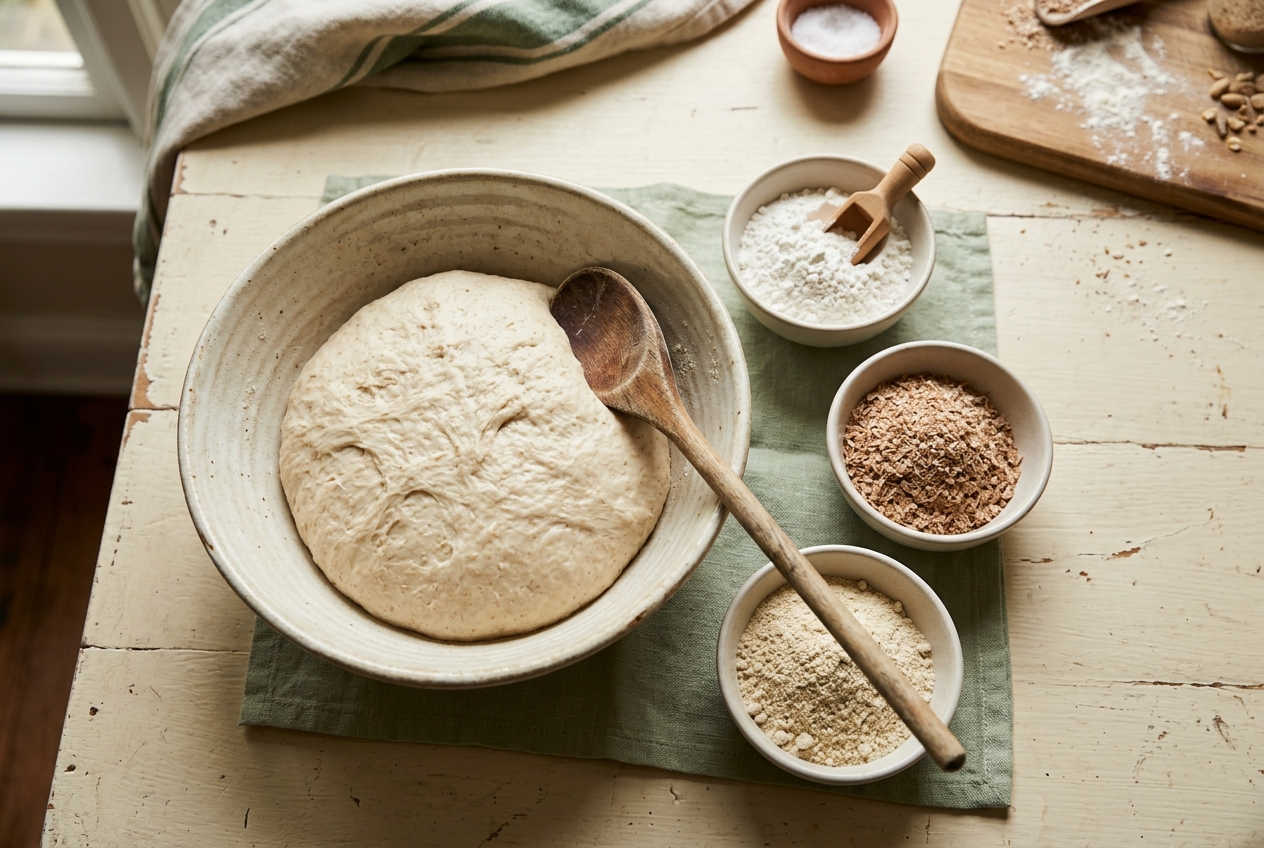
Traditional wheat bread relies on starch, gluten, water, and fermentation working together. Many low-carb loaves replace a meaningful share of digestible starch with ingredients such as resistant wheat starch, oat fiber, cellulose, inulin, seed meals, or concentrated wheat proteins. That can create several production challenges:
- The dough may absorb more water and become sticky or stiff.
- Fiber can interfere with the gluten network that holds fermentation gases.
- A high-protein formula may become tight, rubbery, or difficult to shape.
- The crumb may firm quickly during storage.
- Color and browning may differ from ordinary bread.
Enzymes are one way to address those issues. Gums, emulsifiers, fats, acids, and careful mixing also play a role. A label that lists enzymes is therefore showing one part of a larger formulation strategy.
Common baking enzymes and what they do
| Enzyme family | Main target | Possible baking purpose |
|---|---|---|
| Amylases | Starch | Support fermentation, browning, crumb softness, or shelf life |
| Xylanases | Arabinoxylans in grain cell walls | Adjust water distribution, dough handling, and loaf volume |
| Proteases | Proteins, including gluten | Relax tight dough and improve extensibility |
| Lipases | Fats and phospholipids | Help crumb structure, dough stability, or softness |
| Glucose oxidase | Glucose and oxygen | Strengthen dough through controlled oxidation |
Amylases
Amylases break large starch molecules into smaller carbohydrates. In ordinary bread, those smaller molecules can help feed yeast and influence browning. Some amylases are also used to slow the firming of the crumb during storage. A low-carb loaf can still contain enough starch for this function even when its digestible-carb total is lower than standard bread.
“Amylase” does not mean the product suddenly contains a large amount of sugar. The final Nutrition Facts panel reflects the tested or calculated nutrient profile for the serving. Read total carbohydrate, dietary fiber, total sugars, and serving weight together.
Xylanases and other fiber-active enzymes
Xylanases act on arabinoxylans, complex carbohydrates found in grain cell walls. Their effect can change how water moves through dough. In a fiber-heavy formula, that may help mixing, gas retention, and loaf volume. Research on breadmaking shows that xylanases and cellulases can alter dough handling and finished texture, but results depend on the flour, dose, and other ingredients.
This does not mean the enzyme erases all fiber or makes the net-carb math invalid. Industrial bakers use small, controlled amounts for a specific processing goal. The label and serving information remain the practical guide for shoppers.
Proteases
Proteases cut proteins into smaller pieces. Bakers can use them to relax dough that is too elastic or difficult to shape. That can be especially relevant when a low-carb formula contains extra wheat gluten or wheat protein isolate. Too much protease activity could weaken structure, so manufacturers must control the type, amount, and processing conditions.
Lipases and oxidation enzymes
Lipases act on fats and related molecules. In baking, the changes they create can support dough stability and crumb texture. Glucose oxidase works differently: it promotes reactions that can strengthen the dough network. These functions help explain why a short word such as “enzymes” may stand behind several very different technical jobs.
Why a label may say only “enzymes”
Ingredient labeling depends on how a substance is used and whether it has a technical effect in the finished food. Some enzyme preparations are treated as ingredients and appear on the ingredient list. Certain substances used only as processing aids may be exempt from ingredient declaration under U.S. rules when the legal conditions are met. Allergen requirements can still matter when a preparation contains protein from a major allergen source.
That is why one loaf may list “enzymes,” another may identify an enzyme more specifically, and a third may not mention one even though enzymes were involved somewhere in processing. The absence of the word is not proof that no enzyme played any role.
Do enzymes change net carbs?
The word “enzymes” alone cannot tell you whether a bread is low in net carbs. Enzymes change ingredients during processing, but the shopper-facing carb information comes from the Nutrition Facts panel and serving size. For a basic calculation, subtract dietary fiber from total carbohydrate when that is the method you follow. Sugar alcohols require separate attention because products and personal tracking approaches differ.
Use our guide to reading a nutrition label for net carbs and our explanation of resistant starch on bread labels when a formula relies heavily on starches and added fiber.
Are enzymes safe?
Food enzymes used in the United States must have a lawful basis for their intended use, such as an applicable food-additive regulation or a conclusion that the use is generally recognized as safe. FDA regulations include multiple enzyme preparations and set conditions for certain uses.
That general regulatory status does not replace personal allergy management. A person with wheat, milk, egg, soy, or sesame allergies should focus on the product’s ingredient list and allergen statement. The source and formulation of an enzyme preparation can matter, and recipes can change. When an allergy is severe, contact the manufacturer about the exact product rather than relying on a general internet list.
How to evaluate a low-carb bread that lists enzymes
- Confirm the serving size. Compare grams per slice, not only the front-of-package claim.
- Read total carbs and fiber. Notice whether a two-slice meal changes the totals substantially.
- Check the first ingredients. Resistant starch, fiber, gluten, protein isolates, and seed meals tell you more about the loaf than “enzymes” by itself.
- Review allergens. Low-carb does not mean gluten-free or allergy-friendly.
- Consider texture and use. A soft sandwich loaf, dense seeded bread, and sturdy toast can all use enzymes for different goals.
- Recheck the package. Online listings and older reviews may show a previous formula.
What the label can and cannot tell you
The ingredient list can show that enzymes are part of the declared formula, but it usually cannot reveal the dose, activity, or exact manufacturing conditions. You also cannot predict your blood-glucose response from the enzyme line. The complete carbohydrate profile, portion size, meal context, and individual response are more relevant.
If you compare two loaves, use the LessCarby bread comparison tool and keep the serving weights visible. A one-slice number can look impressive while the slice is much smaller than the alternative.
Frequently asked questions
Are enzymes the same as preservatives?
No. Enzymes speed up specific reactions. Preservatives are used to slow spoilage or unwanted microbial growth. An enzyme may help bread stay soft, but that is different from acting as a mold inhibitor.
Are enzymes gluten?
No. Enzymes and gluten are different proteins. However, a bread that contains enzymes may also contain wheat gluten, and the enzyme preparation itself can have a source or carrier that matters for allergen labeling.
Does baking destroy all enzymes?
Baking heat reduces or stops the activity of many enzymes, but it is too broad to say every enzyme is completely destroyed under every baking condition. The exact temperature history and enzyme type matter.
Should I avoid bread because it lists enzymes?
Not automatically. Judge the complete formula, nutrition panel, allergens, portion, and how the bread works for you. “Enzymes” is a processing clue, not a nutrition verdict.
Practical takeaway
Enzymes help manufacturers make challenging dough more predictable. In low-carb bread, they can support handling, rise, crumb softness, and consistency when fiber and concentrated proteins change the normal breadmaking balance. Read the term in context. The serving size, carb and fiber numbers, first ingredients, allergens, and actual eating quality should carry more weight in your decision.
Sources: 21 CFR Part 170, FDA food-additive definitions; 21 CFR Part 173, enzyme preparations; review of enzyme applications in baking.
\n
Save This Post on Pinterest
Plan Your Week with Our Free Meal Planner
Choose seven days of meals, adjust portions, and download your shopping list. No email signup needed.
Open the Free Planner →
