\n\n
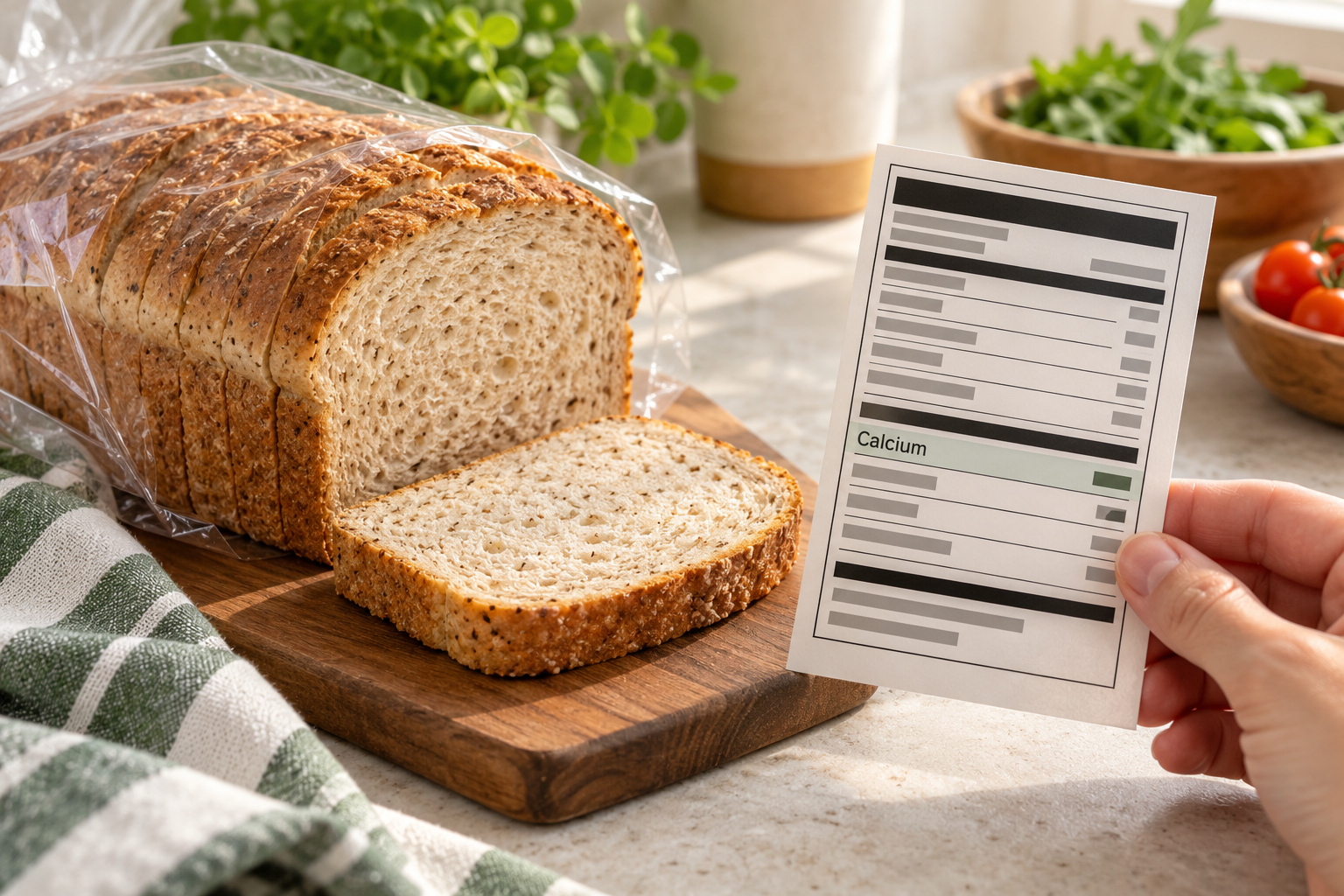
Calcium can be a useful line on a low-carb bread label, but it should not decide the whole purchase. Start with the serving size, then compare the calcium amount and % Daily Value for the amount of bread you will actually eat. After that, check total carbohydrate, fiber, protein, sodium, allergens, and the ingredient list.
Quick answer: The current U.S. Daily Value for calcium is 1,300 mg for adults and children age 4 and older. On a Nutrition Facts label, 5% Daily Value or less per serving is considered low and 20% or more is considered high. Those are comparison guides, not a promise that one loaf will meet your individual needs.
Why calcium appears on the label
Calcium is one of the nutrients that U.S. packaged-food labels must show as both an amount and a % Daily Value. The U.S. Food and Drug Administration explains that vitamin D, calcium, iron, and potassium are required on the Nutrition Facts label. That makes calcium easier to compare across two loaves than many optional vitamins and minerals.
Calcium supports bones and teeth, muscle movement, nerve signaling, blood-vessel function, and hormone release. Those jobs matter, but the amount a person needs varies with age and life stage. The National Institutes of Health calcium fact sheet lists different recommended amounts for children, teens, adults, pregnancy, and older adulthood. The label’s 1,300 mg Daily Value is a standard reference for comparison; it is not a personalized prescription.
Read the serving size before the calcium number
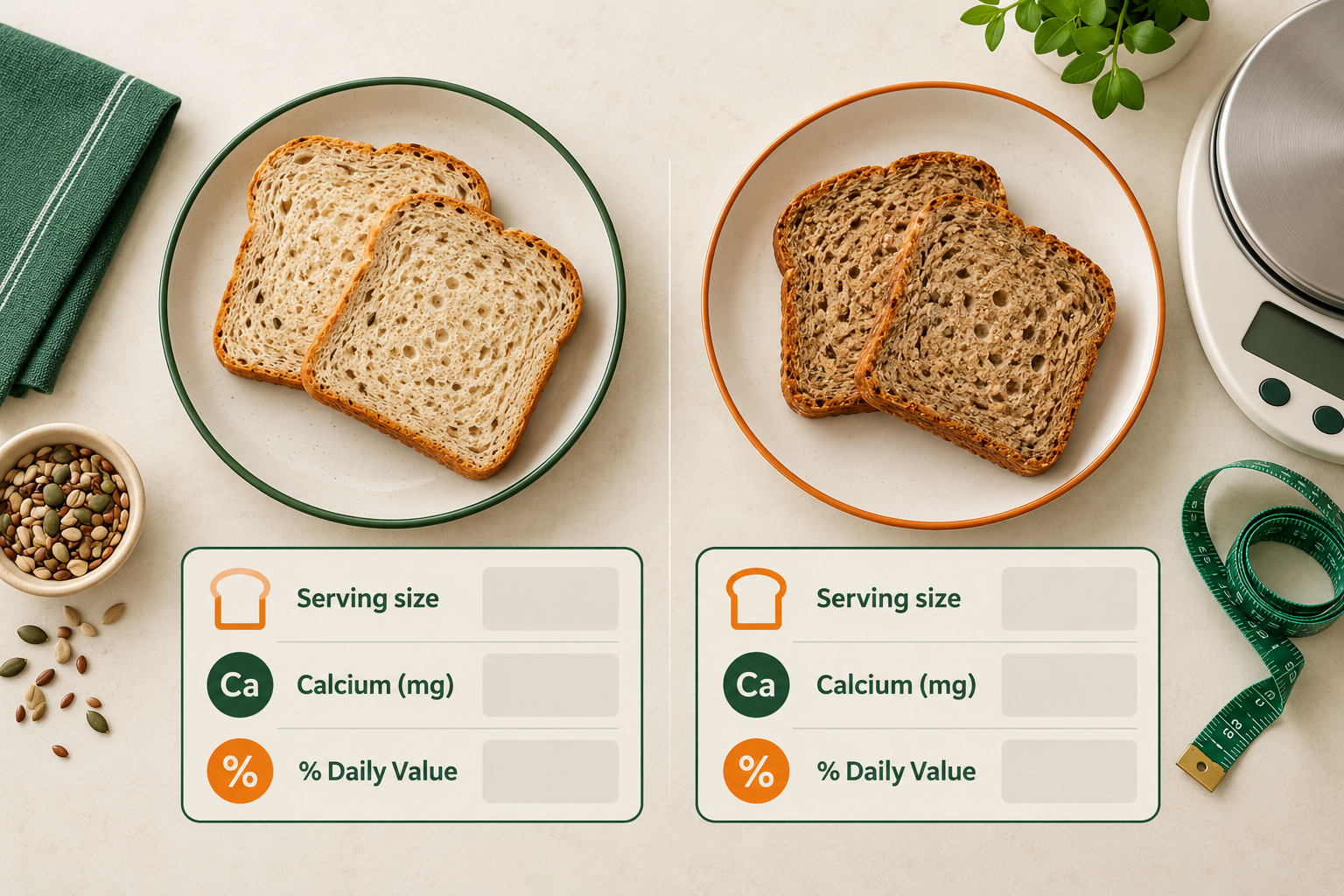
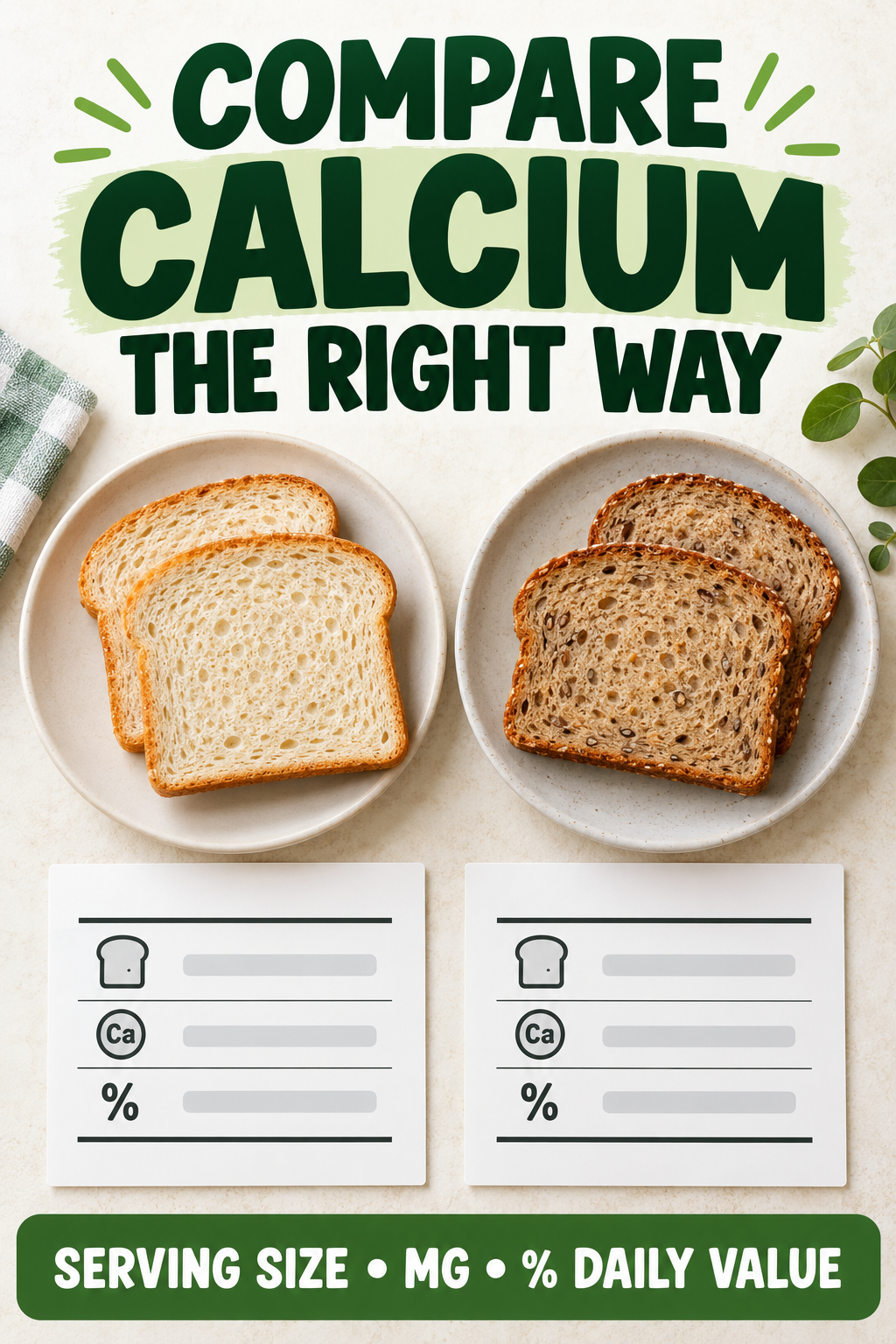
A calcium number is only meaningful when you know what counts as one serving. One bread label may use one slice, while another may use two. Slice weights can differ too. If you normally eat two slices, a one-slice label needs to be doubled. If the package defines two slices as the serving, do not double it again.
Use this order:
- Find the labeled serving. Note the number of slices and gram weight.
- Match it to your portion. Decide how many labeled servings you will eat.
- Read calcium in milligrams and %DV. The percentage puts the amount on the same reference scale across products.
- Compare like with like. Convert both loaves to one slice, two slices, or the same gram weight before choosing.
For example, imagine Bread A lists 130 mg of calcium in a two-slice serving and Bread B lists 80 mg in a one-slice serving. Bread B has less calcium per labeled serving, but 160 mg for two slices. That does not make Bread B automatically better; it simply shows why serving size must come first. These example numbers are arithmetic demonstrations, not values for any particular product.
\n\n
What the % Daily Value tells you
The % Daily Value shows how much one labeled serving contributes to the standard Daily Value. According to the FDA, 5% DV or less is considered low and 20% DV or more is considered high. A food between those points still contributes calcium; it just does not fall into either quick-reference end of the scale.
| Calcium on the label | How to read it |
|---|---|
| 5% DV or less | Low per labeled serving |
| 10%–19% DV | A meaningful contribution; this range also aligns with the federal “good source” definition when claim rules are met |
| 20% DV or more | High per labeled serving |
The percentage is convenient, but milligrams are helpful when you are adding up foods across a day or following advice from a clinician or dietitian. Keep both numbers in view.
Where the calcium may come from
Most grains do not naturally contain large amounts of calcium unless they are fortified. NIH notes that breads and other grain foods can still add to total intake because people eat them regularly. A higher-calcium loaf may include a calcium-containing ingredient, a dairy ingredient, or added fortification, but the Nutrition Facts panel alone does not tell you the exact source.
Check the ingredient list for clues such as calcium carbonate, calcium sulfate, calcium phosphate, or dairy ingredients. Do not assume every unfamiliar ingredient is there mainly for nutrition. Some calcium compounds may also serve technical purposes in food production. The list is ordered by weight, and a small amount can still affect the nutrient panel.
“Enriched” and “fortified” are not interchangeable shortcuts for a complete nutritional profile. Our guide to enriched versus fortified low-carb bread explains why the front of the package should send you back to the actual label.
Calcium does not cancel out the rest of the label
A bread can be high in calcium and still be a poor fit for your priorities. Use the same serving-size check for the nutrients that matter to you:
- Total carbohydrate and fiber: Look at the regulated Nutrition Facts lines before relying on a front-label net-carb claim. Our net-carb label guide walks through that comparison.
- Sodium: Bread can contribute meaningful sodium across several slices, fillings, cheese, or spreads.
- Protein: Compare grams per equal portion rather than assuming “keto” or “protein” wording guarantees more.
- Ingredients and allergens: Low-carb breads commonly use wheat proteins, fibers, seeds, soy, eggs, or dairy. Read the allergen statement every time the product changes.
- Calories and portion: A thicker or denser slice may change both the serving experience and the totals.
Calcium is best treated as one line in a whole-label decision. If two breads work equally well for your carbohydrate target, taste, budget, and allergies, the calcium difference may be a useful tie-breaker. It should not be used to overlook a mismatch elsewhere.
Natural calcium, fortification, and absorption
The body does not absorb every milligram from every food in exactly the same way. NIH notes that absorption varies with the food source and other factors, including vitamin D status. That does not make the label useless. It means the label measures how much calcium the food contains, not precisely how much your body will absorb from that serving.
For most shoppers, there is no need to rank bread ingredients by theoretical absorption. Use the label to compare products, and build calcium intake from a varied eating pattern. Dairy foods, canned fish with edible bones, some greens, calcium-set tofu, and fortified beverages are common sources. Bread can contribute, but it does not need to carry the whole job.
A practical shopping checklist
- Confirm the exact product and flavor; similar packages can use different formulas.
- Check whether the serving is one slice or two and note the gram weight.
- Compare calcium in both mg and %DV for your real portion.
- Look for calcium-related front-label claims, then verify them on the Nutrition Facts panel.
- Review total carbohydrate, fiber, sodium, protein, calories, ingredients, and allergens.
- Recheck the bag when you buy it again. Formulas and serving sizes can change.
Frequently asked questions
Is low-carb bread usually high in calcium?
Not necessarily. Calcium varies by formula and fortification. The only reliable answer for a specific loaf is the current Nutrition Facts label.
Does 10% Daily Value mean 130 mg?
Using the current 1,300 mg Daily Value, 10% corresponds to 130 mg. Label rounding can affect the displayed figures, so use the printed amount and %DV rather than trying to reverse-engineer an exact value.
Is a high-calcium bread automatically healthier?
No. “Healthier” depends on the full product and the person. Calcium is useful, but so are serving size, carbohydrate, fiber, sodium, protein, ingredients, allergens, and the rest of the diet.
Should I choose bread to meet all my calcium needs?
Bread can contribute, especially when fortified, but a varied diet usually provides a better foundation. If you have osteoporosis, kidney disease, digestive conditions, a milk allergy, or a clinician-directed calcium target, ask a qualified health professional how the label fits your plan.
Save This Post on Pinterest
Keep this label-reading guide handy for your next bread comparison.
Bottom line: Read calcium in context. Match the serving to your portion, use mg and %DV for comparison, and keep the rest of the label in the decision. That gives you a clearer answer than any single claim on the front of the bag.
\n\n
Plan Your Week with Our Free Meal Planner
Choose seven days of meals, adjust portions, and download your shopping list. No email signup needed.
Open the Free Planner →
