

Last updated:
If you’ve ever stood in the bread aisle squinting at a Nutrition Facts panel trying to do subtraction in your head, you’re not alone. Once you know what net carbs are, the next skill is finding the three numbers you need on any package — fast, and without getting fooled by serving-size tricks or sugar-alcohol math.
This guide walks through exactly where those numbers live on the label, the formula to use, and the mistakes that trip up even experienced low-carb shoppers.
What “Net Carbs” Actually Means (and Why the FDA Doesn’t Define It)
Here’s something that surprises a lot of people: “net carbs” is not an official FDA term. It doesn’t appear anywhere on a legally required Nutrition Facts label. It’s a consumer and marketing shorthand. Fiber is commonly subtracted from total carbs because many fibers are not digested and absorbed like starch or sugar, while sugar alcohols require separate judgment.
A net-carb number is the manufacturer’s calculation. The required Nutrition Facts panel follows federal labeling rules, including rounding allowances; this does not mean the FDA has independently tested every package.
Start with the required Nutrition Facts panel rather than waiting for a front-of-package claim to explain the calculation. The FDA label guide shows how to read servings, total carbohydrate, and fiber.
Three Numbers to Check on the Label
Every net carb calculation starts in the same section of the label: the carbohydrate block, below the fat, cholesterol, and sodium information.
| Label Term | Where to Find It | Why It Matters |
|---|---|---|
| Total Carbohydrate | Bolded line in the carb section | Your starting number — includes every type of carb in the food |
| Dietary Fiber | Indented under Total Carbohydrate | Commonly deducted in net-carb arithmetic; not a measurement of individual absorption |
| Sugar Alcohol (erythritol, xylitol, maltitol, etc.) | When declared, in the carbohydrate section | Optional calculation adjustment; do not assume every type has the same effect |
Total Sugars and Added Sugars are useful for other reasons, but they’re already included inside Total Carbohydrate — you don’t subtract those separately.
The Net Carb Formula (Step-by-Step)
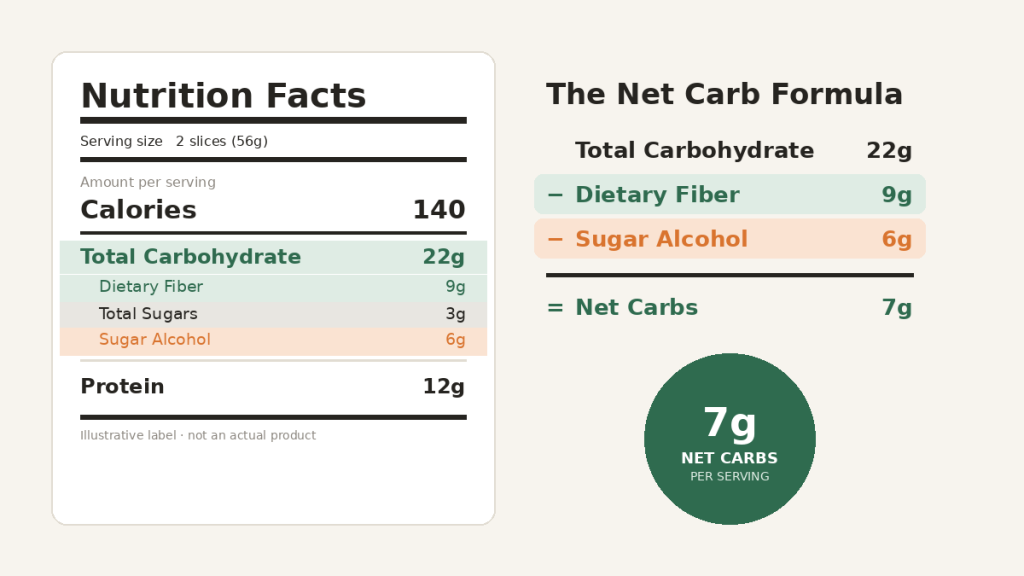
Net Carbs = Total Carbohydrate − Dietary Fiber − Any Explicitly Chosen Sugar-Alcohol Deduction
Begin with total carbohydrate minus fiber. If you choose to deduct sugar alcohols, use their stated grams and show the assumption separately. Allulose is a sugar, not a sugar alcohol. Do not enter it in the sugar-alcohol field or assume it appears in every low-carb bread.
Here is an illustrative calculation, assuming a full deduction of 6 g listed sugar alcohols. It is an arithmetic example, not a prediction of absorption:
| Nutrition Facts Line | Grams |
|---|---|
| Total Carbohydrate | 22g |
| − Dietary Fiber | 9g |
| − Sugar Alcohol (erythritol) | 6g |
| = Net Carbs | 7g |
Grab the label, plug in your own numbers, or skip the mental math with our Net Carb Calculator — choose a deduction and see each step.
Not All Sugar Alcohols Subtract the Same Way
The percentages below compare methods of calculation. They are not recommended absorption percentages for individual sweeteners. The ADA explains that fiber and sugar alcohols can be partly digested and recommends using total carbohydrate for diabetes carb counting.
| Method | Example: 20 g total, 5 g fiber, 6 g sugar alcohols |
|---|---|
| No sugar-alcohol deduction | 15 g estimated net carbs |
| Subtract half the stated amount | 12 g estimated net carbs |
| Subtract all the stated amount | 9 g estimated net carbs |
Allulose is treated separately: it remains in total carbohydrate on U.S. labels, although FDA guidance allows it to be excluded from total and added sugars. See the FDA explanation. Our calculator does not deduct it.
Common Label-Reading Mistakes That Inflate (or Hide) Net Carbs
- Serving size games. A “net carbs per serving” claim means nothing if the serving size is unrealistically small — always check grams or slice count, not just the marketing claim.
- Rounding down. Manufacturers can round fiber and sugar alcohol grams, so subtraction of the rounded values may not match a calculation from unrounded data.
- Treating all sugar alcohols as free. A full deduction is an assumption, not proof that a sweetener has no glucose effect.
- Ignoring “per 2 servings” labeling. Some packaged breads list nutrition per 2 slices — double-check you’re not accidentally halving your real net carb count.
- Trusting the front-of-package claim over the actual label. Read the Nutrition Facts panel and ingredient list. A regulated panel is not an FDA taste test or a guarantee of personal glucose response.
FAQ
Is “net carbs” recognized by the FDA?
No. It’s a consumer-facing calculation, not a defined or regulated term. The Total Carbohydrate, Dietary Fiber, and Sugar Alcohol numbers it’s based on are regulated; the net carbs math itself is not.
Does fiber always subtract fully from total carbs?
Subtracting all labeled fiber is a common net-carb convention, not a clinical rule. Follow your care team’s counting method if you manage diabetes. Do not subtract fiber again from a label that already excludes it from available carbohydrate.
Can sugar alcohols still raise blood sugar?
Some can, especially maltitol, and effects vary by individual. If you’re diabetic or closely managing blood sugar, it’s worth testing your own response rather than assuming a manufacturer’s net carb number applies to you.
What if a package doesn’t list “net carbs” at all?
That’s normal — remember, it’s not a required label term. Use the Total Carbohydrate, Dietary Fiber, and Sugar Alcohol lines and do the subtraction yourself (or run it through our calculator).
Want the full basics first? Start with What Are Net Carbs? The Simple Guide Every Low-Carb Beginner Needs, then use the Net Carb Calculator to check any label in seconds.
As an Amazon Associate, I earn from qualifying purchases.
Browse low-carb bread options on Amazon →
Plan Your Week with Our Free Meal Planner
Choose seven days of meals, adjust portions, and download your shopping list. No email signup needed.
Open the Free Planner →
