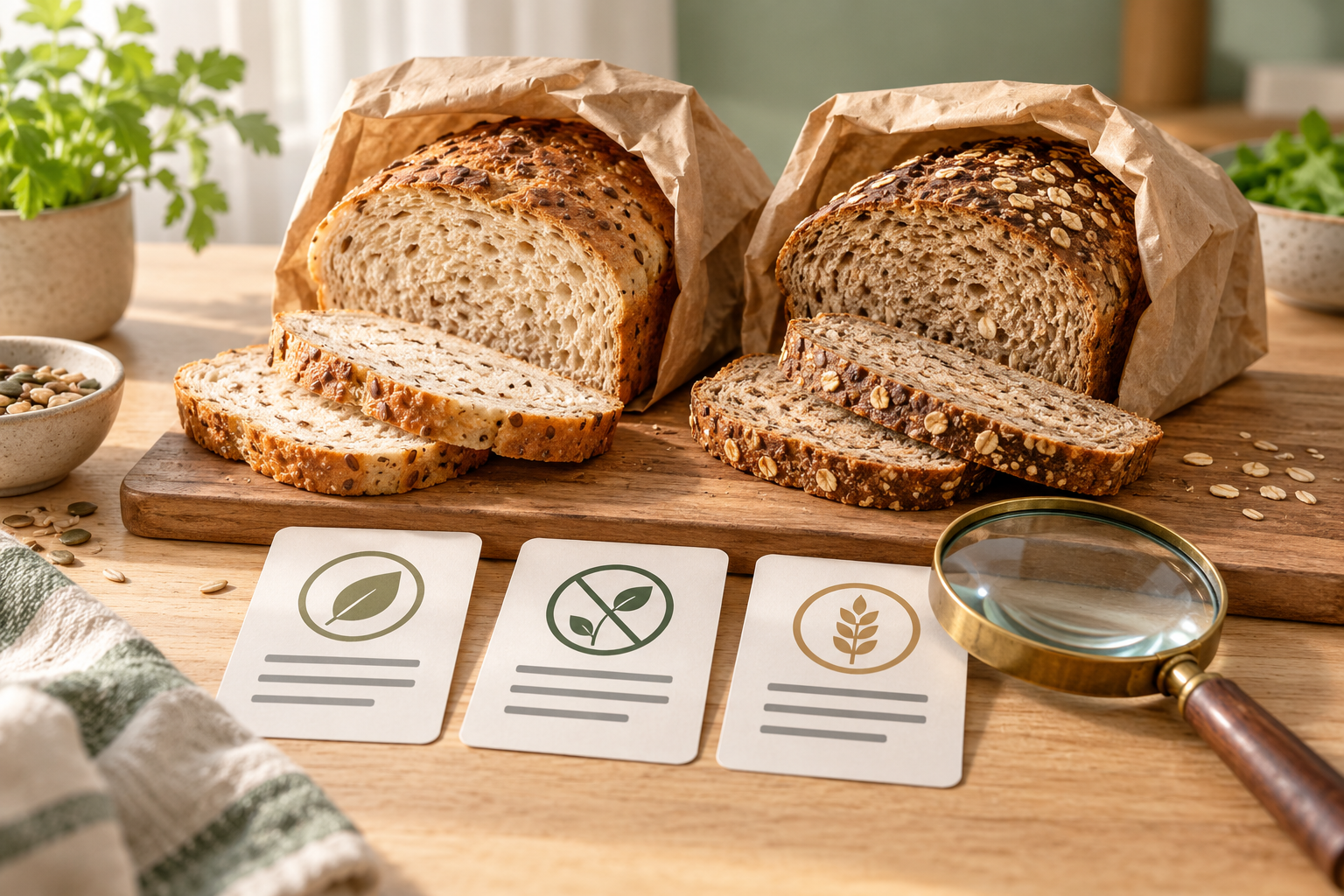
Short answer: “organic,” “non-GMO” and “low-carb” describe different things. An organic claim tells you how ingredients were produced and certified. A non-GMO or federal bioengineered-food statement addresses genetic-engineering disclosure. Neither one tells you how many carbohydrates are in a slice. For that, check the serving size, total carbohydrate and dietary fiber on the Nutrition Facts panel.
Organic and non-GMO are not carb claims
A loaf can be certified organic and still contain more carbohydrate than another loaf. A non-GMO loaf can also be high or low in carbohydrate. These front-of-package terms answer sourcing and production questions, while the Nutrition Facts panel answers the amount-per-serving question.
That distinction matters with low-carb bread because the front may carry several badges at once. Treat each badge as one piece of information. Start with the priority that brought you to the package: certified production practices, avoidance of certain bioengineered ingredients, carbohydrate amount, allergens, or a combination of those.
If the carbohydrate terms feel unfamiliar, our low-carb bread ingredient glossary explains common fibers, starches, proteins and label numbers. Our broader guide to what carbohydrates are explains sugars, starches and fiber.
What the USDA Organic seal means
The USDA Organic seal is a government-backed certification claim. Certified operations must follow the National Organic Program’s production, handling, recordkeeping and inspection requirements. For multi-ingredient foods such as bread, the wording on the package tells you how much of the product qualifies.
Four organic-label situations
- “100 percent organic”: the agricultural ingredients are organic, apart from water and salt, which are excluded from the percentage calculation.
- “Organic”: at least 95 percent of the ingredients are certified organic, excluding water and salt. The remaining portion must meet the program’s restrictions.
- “Made with organic…”: at least 70 percent of the ingredients are certified organic, excluding water and salt. This wording may name up to three ingredients or ingredient groups, but the package may not use the USDA Organic seal.
- Specific organic ingredients: a product below the 70 percent threshold may identify particular organic ingredients in the ingredient list, but it cannot present the finished loaf as organic.
The USDA explains these categories in its current organic product labeling guide. The exact wording is useful: “made with organic wheat” does not mean every agricultural ingredient in the loaf is organic.
Organic certification and genetic engineering
USDA organic production rules prohibit excluded methods, including genetic engineering, in certified organic production. That makes the USDA Organic seal relevant when your goal is to buy food produced under that certified system. It is still a process claim, not a promise about a bread’s carbohydrate count, sodium, protein, texture or suitability for a medical diet.
A seal also does not make allergen checks optional. Organic wheat still contains wheat, and an organic loaf may contain sesame, soy, milk, eggs or tree nuts. Read the ingredient list and allergen statement every time, especially when a brand changes a formula.
What “non-GMO” and “bioengineered” can mean
U.S. federal packages use the term bioengineered for the mandatory disclosure standard. USDA defines a bioengineered food as one containing detectable genetic material modified through specified laboratory techniques when the modification could not be obtained through conventional breeding or found in nature.
The National Bioengineered Food Disclosure Standard requires covered manufacturers, importers and certain retailers to disclose qualifying bioengineered foods or ingredients. A disclosure may appear as text, a symbol, an electronic or digital link, or a text-message option, depending on the applicable rules.
Why an absent disclosure is not the same as a broad non-GMO guarantee
The federal standard is tied to its legal definition and detectability. USDA’s bioengineered-food FAQ notes that highly refined ingredients may not require disclosure when modified genetic material is no longer detectable and the records support that conclusion. Small manufacturers and certain foods also have different requirements or exemptions.
Private “Non-GMO” seals are separate voluntary programs with their own standards and verification systems. If that claim matters to you, identify who issued the seal and read that program’s standard rather than assuming every non-GMO statement means the same thing.
USDA also states that a bioengineered-food disclosure does not, by itself, convey a health, safety or environmental judgment. Use it to answer the disclosure question, then evaluate nutrition and ingredients separately.
How to tell whether the bread fits your carb target
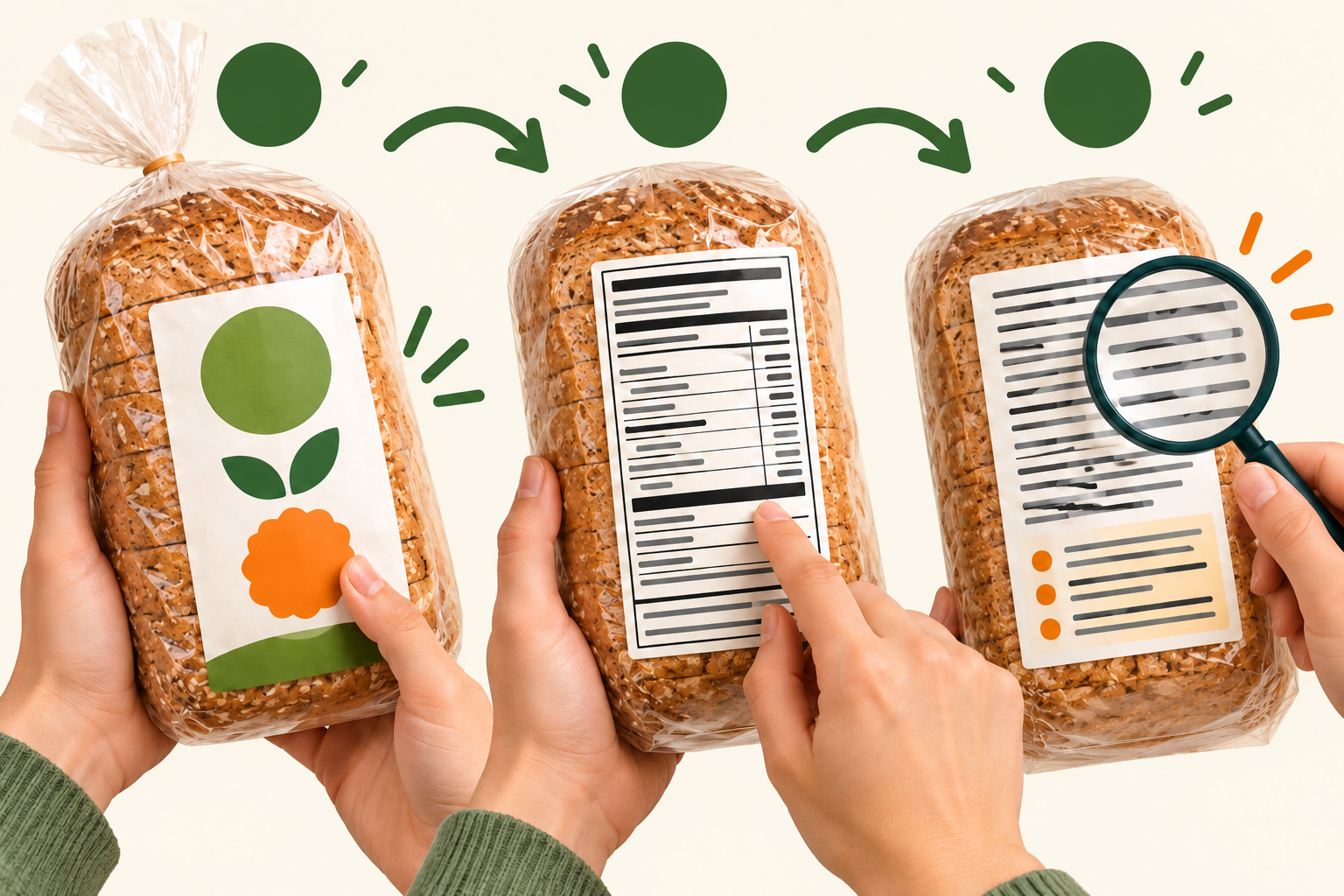
Turn the package to the Nutrition Facts panel. The FDA’s label-reading guide recommends comparing products with the same serving size. For bread, that means checking both the number of slices and the weight in grams.
- Confirm the serving. One brand may list one slice while another lists two. Convert the numbers to the portion you actually plan to eat.
- Read total carbohydrate. This regulated line includes sugars, starch and dietary fiber.
- Check dietary fiber. Fiber is already included within total carbohydrate. Do not add it to the total.
- Treat “net carbs” as a brand calculation. The phrase is common on low-carb packages, but the arithmetic and handling of sugar alcohols can vary. Read the company’s explanation and compare the underlying regulated numbers.
- Look beyond carbs. Review sodium, protein, saturated fat and added sugars in the portion you will eat. No single front label replaces the full panel.
For example, if a label lists 9 grams of total carbohydrate and 7 grams of dietary fiber per slice, the simple subtraction often used on packaging is 2 grams. Two slices would use 18 grams of total carbohydrate and 14 grams of fiber before any other permitted adjustment. That example only demonstrates the arithmetic; it is not a nutrition estimate for a particular loaf.
Ingredients that deserve a second look
Low-carb breads often use wheat gluten, protein isolates, modified starches, cellulose, oat fiber, psyllium, inulin, gums, seeds or nuts to replace some conventional flour. Organic certification does not make those ingredients disappear, and a non-GMO claim does not tell you how much of each is present.
Read the first several ingredients to understand the loaf’s basic structure. Then check ingredients that matter for your digestion, allergies or preferences. A high-fiber loaf can be useful, but a sudden large portion may not suit everyone. Start with the serving you intend to eat rather than assuming a bigger fiber number is automatically better.
Also compare the physical slice. A very small serving can make the per-slice number look lower even when a same-weight comparison is less dramatic. When two packages differ, compare equal grams or the full sandwich portion.
A practical decision guide in the bread aisle
Choose certified organic when
You want the USDA-certified production and handling system, and the exact loaf also meets your carbohydrate, ingredient, allergen and budget priorities. Check whether the package says “100 percent organic,” “organic,” or “made with organic…” because those claims are not interchangeable.
Choose a verified non-GMO option when
Avoiding ingredients covered by the verifier’s standard is a personal priority. Confirm the organization behind the mark and remember that a voluntary seal and the federal bioengineered-food disclosure are different systems.
Choose by the Nutrition Facts panel when
Your main goal is a specific carbohydrate range for a sandwich, toast or meal. Compare the portion you will really eat, not only the largest front-of-package number. If a clinician has given you a carbohydrate plan, use that individualized target rather than a generic “keto” badge.
The bottom line
An organic seal can be meaningful, and a carefully verified non-GMO claim can answer a real shopping preference. Neither one turns an ordinary loaf into low-carb bread. Read the claims in their proper lanes: production and certification on the front, carbohydrate and fiber per serving in the Nutrition Facts panel, and the bread’s structure and allergens in the ingredient list.
That three-part check takes less than a minute once you know where to look. It also prevents the most common label mistake: treating one reassuring badge as a summary of the whole product.
Save This Post on Pinterest
Keep this label-reading guide handy for your next bread-aisle comparison.
Plan Your Week with Our Free Meal Planner
Choose seven days of meals, adjust portions, and download your shopping list. No email signup needed.
Open the Free Planner →
