

For most low-carb bread recipes, allulose is usually better when you want browning and a sugar-like softness, while erythritol is better when you want a dry, clean sweetness with almost no effect on blood glucose. Neither behaves exactly like sugar, and neither automatically makes a loaf healthy or low-carb. The better choice depends on texture, baking temperature, digestive tolerance, and the finished Nutrition Facts label.
Quick distinction: Erythritol is a sugar alcohol. Allulose is a rare sugar, not a sugar alcohol. Both supply far fewer usable calories than table sugar, but their chemistry and baking behavior are different.
Erythritol vs. allulose at a glance
| Feature | Erythritol | Allulose |
|---|---|---|
| Type | Sugar alcohol | Rare sugar |
| Sweetness | Less sweet than sugar, often with a cooling sensation | Less sweet than sugar, with a more sugar-like taste |
| Browning | Limited browning | Browns readily and can darken quickly |
| Texture | Can recrystallize or feel slightly gritty | Helps retain softness and moisture |
| Best fit | Dry toppings, crisp applications, blends | Soft bread, rolls, glazes, browned crusts |
These are practical baking differences, not health rankings. A small amount in a yeast loaf performs differently from the larger quantities used in candy, syrup, or dessert.
What is erythritol?
Erythritol belongs to the sugar-alcohol family, along with xylitol, sorbitol, maltitol, and several others. Despite the name, sugar alcohols are not alcoholic beverages. They are carbohydrates with a chemical structure that resembles aspects of both sugars and alcohols.
The FDA treats erythritol differently from most other sugar alcohols when calculating calories on U.S. labels: its general caloric factor is zero calories per gram. It is absorbed largely in the small intestine and excreted, which helps explain its minimal immediate effect on blood glucose. It is also less likely than some sugar alcohols to reach the colon in large amounts, though high intakes can still cause digestive discomfort in some people.
Erythritol is less sweet than table sugar and often produces a cooling sensation. Granulated erythritol may recrystallize after baking or cooling, leaving a slightly crisp or gritty texture. Powdered erythritol and blends can reduce that effect but do not eliminate its basic behavior.
What is allulose?
Allulose is a monosaccharide, or single sugar, found naturally in very small amounts in some foods and manufactured for use as a sweetener. It resembles fructose structurally but is metabolized differently. In its current labeling guidance, the FDA allows allulose to be excluded from the “Total Sugars” and “Added Sugars” lines while it remains included in “Total Carbohydrate.” The agency uses 0.4 calories per gram when calculating calories from allulose.
Allulose dissolves readily, holds moisture, and participates in browning reactions. Those qualities make it useful in baked goods, but they also mean a recipe can brown before the center is fully baked. A lower oven temperature or earlier foil cover may be needed when a recipe contains a meaningful amount.
Because allulose retains moisture and depresses freezing point, it is popular in soft baked goods, sauces, and frozen desserts. In bread, it can support a softer crumb and deeper crust color, but too much may produce a sticky loaf or an overly dark exterior.
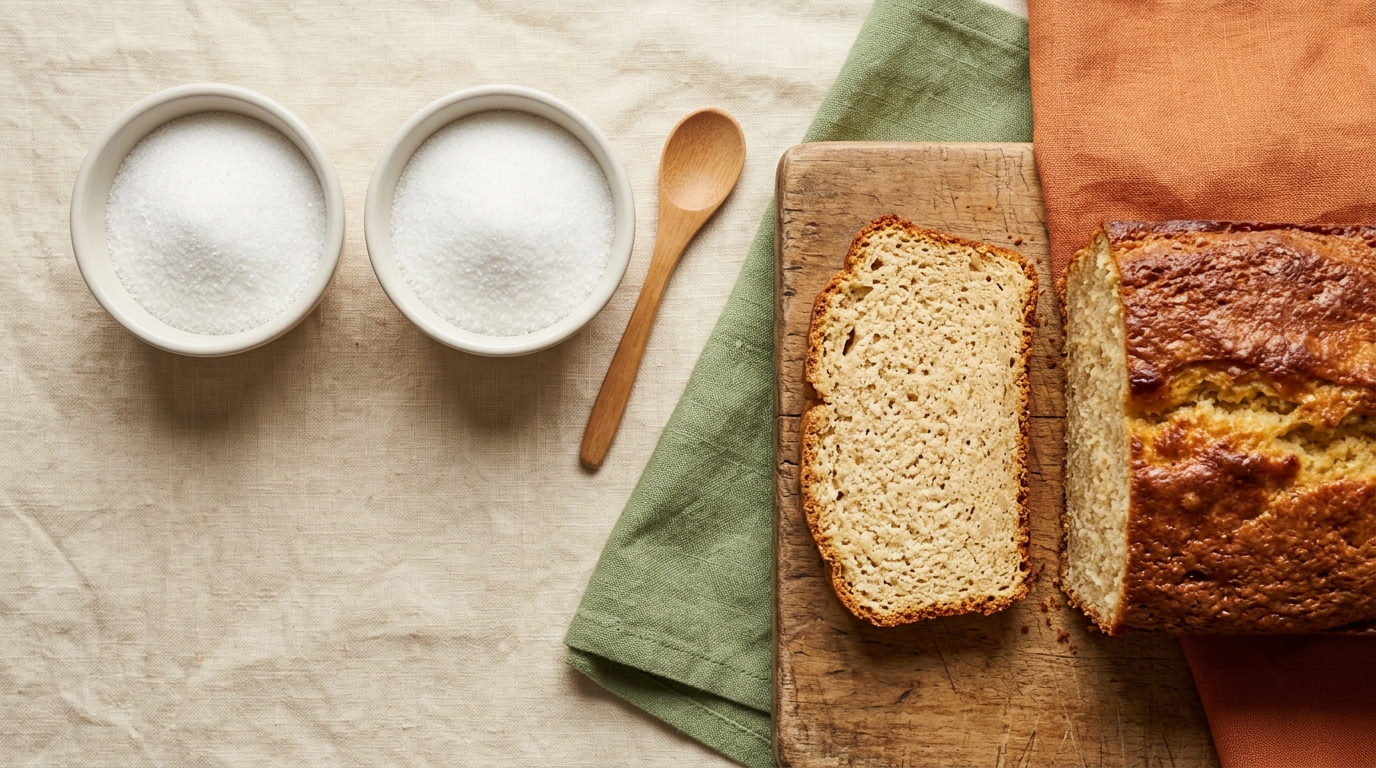
Which one works better in low-carb bread?
Allulose generally has the edge for a soft sandwich loaf because it browns and helps retain moisture. Erythritol can work when sweetness is subtle or when it is blended with another sweetener, but it does not provide the same browning and may recrystallize as the bread cools.
Choose allulose when you want:
- a softer crumb that stays moist longer;
- more visible crust browning;
- a taste closer to ordinary sugar; or
- a glaze or spread that remains smooth rather than crystalline.
Choose erythritol when you want:
- a drier finish or slightly crisp topping;
- minimal browning from the sweetener;
- a formula already designed around erythritol; or
- to use a proven erythritol blend rather than reformulating the recipe.
Do not swap them cup for cup in an untested bread formula. Sweetness, water binding, browning, yeast activity, and final volume can all change. Start with a recipe written for the chosen sweetener and make small adjustments between batches.
Do erythritol and allulose raise blood sugar?
Both generally produce a much smaller immediate glucose response than table sugar, but “smaller” does not mean every finished food is glucose-neutral. Bread also contains starches, fibers, flour replacements, and other ingredients. Portion size and personal response matter.
Small acute human studies have examined allulose and erythritol without showing the glucose rise expected from an equivalent sugar dose. A 2023 meta-analysis reported that 10 grams of allulose modestly reduced post-meal glucose exposure in the included trials. These findings do not prove that either sweetener treats diabetes or that a bread containing one will have a predictable effect for every reader.
For packaged bread, start with our guide to reading net carbs on a Nutrition Facts label. Our bread guide for people with diabetes also explains why testing your own response can be more useful than relying only on front-of-package claims.
What about digestion?
Digestive tolerance varies. The FDA notes that sugar alcohols can cause gas, bloating, or diarrhea because absorption and fermentation differ among products and people. Erythritol is often tolerated better than sorbitol or maltitol, but a large serving can still cause symptoms.
Allulose can also cause gastrointestinal discomfort at higher intakes. The amount in one slice of bread may be modest, but intake adds up across sweetened drinks, bars, desserts, and multiple bread servings. Introduce unfamiliar sweeteners gradually and pay attention to serving size.
Practical tip: When a high-fiber bread also contains a low-calorie sweetener, digestive effects may come from the combination rather than one ingredient alone. Check the full ingredient list and serving size.
If added fiber is also a concern, read how much fiber may be too much at one sitting and our explanation of soluble versus insoluble fiber in low-carb bread.
What does current research say about erythritol and heart risk?
Recent research has raised a legitimate question but has not established that ordinary dietary erythritol causes heart attacks or strokes. A 2023 study found that higher blood erythritol levels were associated with major cardiovascular events and included laboratory and small intervention findings related to clotting. An NIH summary emphasized that the results warrant further study.
Important limitations remain. The observational participants often already had cardiovascular risk factors, the body can produce erythritol internally, and an association in blood does not by itself prove that eating erythritol caused the outcomes. Later small studies have continued to examine platelet activity, but large, long-term randomized trials are still lacking.
The sensible conclusion is caution rather than panic. People with cardiovascular disease, diabetes, or other risk factors can discuss frequent or high-dose erythritol use with a clinician. Avoid using this article to stop prescribed treatment or to diagnose a health condition.
How to find each sweetener on a bread label
- Read the ingredient list. Ingredients appear in descending order by weight. “Erythritol” and “allulose” should be named directly.
- Check total carbohydrate. Both can appear within total carbohydrate even when they are handled differently elsewhere on the label.
- Look for sugar alcohol disclosure. The sugar-alcohol line may be voluntary in some circumstances, so do not assume zero when the line is absent.
- Check the brand’s net-carb explanation. Determine exactly what the manufacturer subtracts.
- Recheck after reformulation. Ingredients and serving sizes can change without the front of the package looking dramatically different.
Our overview of low-carb bread ingredients puts sweeteners in context with vital wheat gluten, modified starch, and added fibers.
Frequently asked questions
Is allulose a sugar alcohol?
No. Allulose is a rare monosaccharide. Erythritol is a sugar alcohol.
Which sweetener tastes more like sugar?
Allulose usually tastes more sugar-like and lacks erythritol’s characteristic cooling sensation. Both are less sweet than table sugar, so commercial blends may include other sweeteners.
Can yeast use erythritol or allulose like sugar?
Do not assume either will feed baker’s yeast the way ordinary sugar does. Bread rise depends on the entire formula, fermentation time, flour system, and available fermentable carbohydrates.
Which one has fewer calories?
For U.S. Nutrition Facts calculations, the FDA assigns erythritol a general factor of zero calories per gram and uses 0.4 calories per gram for allulose. The finished food’s calories still come from all ingredients.
The practical choice
Choose allulose for a soft, browned loaf and erythritol for a drier, less-browned result or a recipe already formulated around it. Follow a tested formula, compare the complete label, and keep portions moderate until you know how your digestion responds. Neither ingredient replaces the need to evaluate the bread as a whole.
Save This Post on Pinterest
Save either comparison for the next time you choose a sweetener for low-carb baking.
Sources
- FDA nutrition-labeling guidance, including allulose
- FDA: Sugar Alcohols and the Nutrition Facts Label
- FDA Nutrition Facts guidance and sugar-alcohol calorie factors
- Human study of acute allulose and erythritol metabolic effects
- Meta-analysis of allulose and post-meal glucose
- 2023 erythritol and cardiovascular-event study
- NIH Research Matters summary of erythritol findings
Plan Your Week with Our Free Meal Planner
Choose seven days of meals, adjust portions, and download your shopping list. No email signup needed.
Open the Free Planner →
