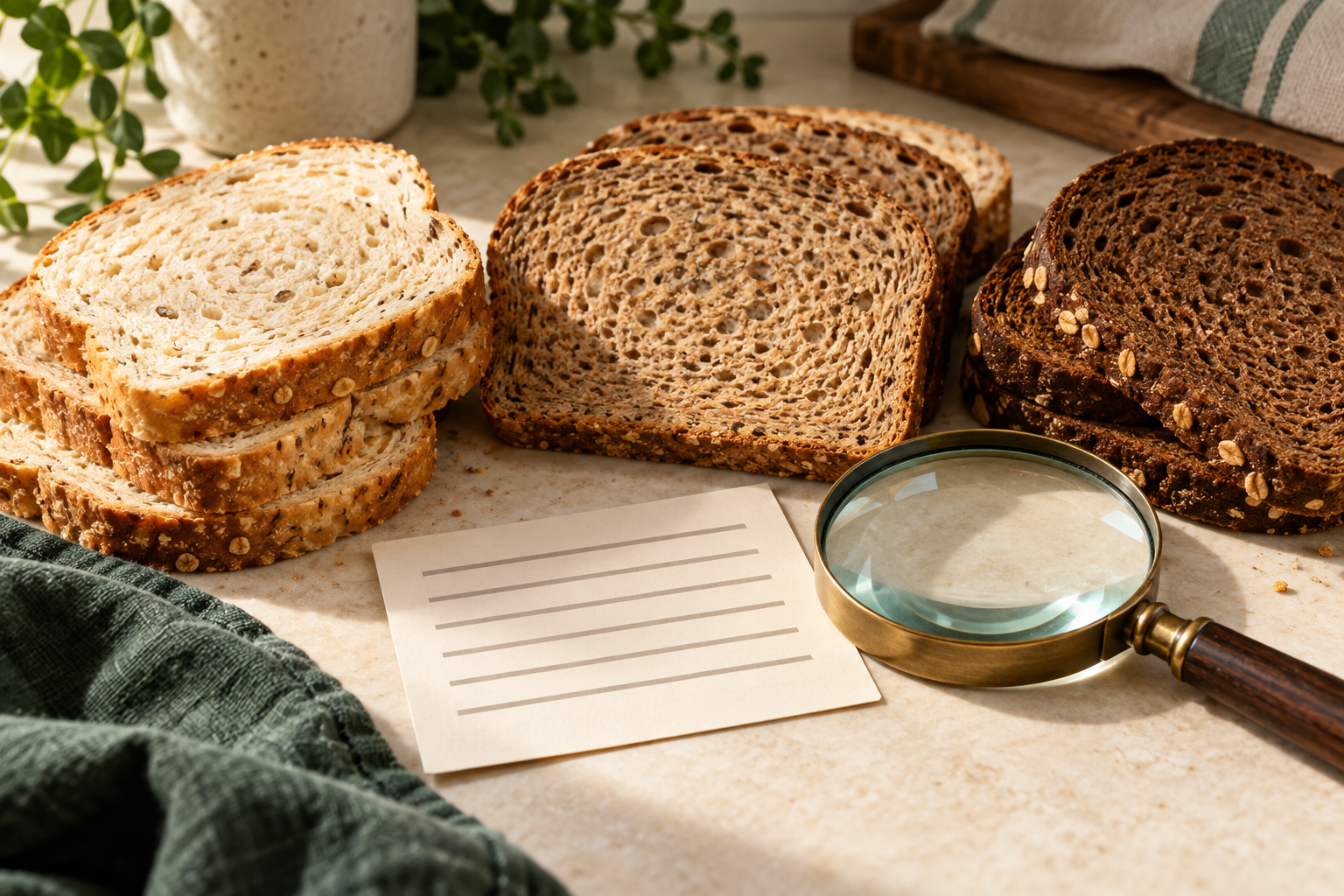
Read the ingredient list, not the shade of the loaf, to find food colorings in low-carb bread. Names such as caramel color, annatto extract, or a numbered dye describe ingredients used for appearance. They do not tell you the bread’s carbohydrate count, whole-grain content, or how it will fit your meals.
Our practical recommendation is to keep two questions separate: does this loaf contain a coloring you want to avoid, and does the rest of its label work for you? You can prefer a bread without added colors without assuming that every darker loaf contains dye or that every pale loaf is a better nutritional choice. This guide covers packaged-food labels in the United States.
What counts as a food coloring?
A color additive is an ingredient used to give color to food. It may come from a synthetic process or a source such as a plant, mineral, or animal. The FDA describes several purposes, including restoring or strengthening color and making appearance more consistent. The name on a package does not necessarily explain why that particular baker chose it. See the FDA’s consumer guide to color additives.
Start with the exact variety you are buying. A brand’s sandwich loaf, seeded loaf, and cinnamon bread can have different ingredient lists. A photograph of another variety is not a substitute, even when the packaging looks similar. We are explaining label terms here, not claiming that a particular low-carb brand uses any of the examples below.
Names and phrases to look for
U.S. rules distinguish colors that require batch certification from those exempt from that process. Exempt does not mean unregulated: permitted uses still need FDA approval. Certified colors must be named on the food label, while most certification-exempt colors can use broader wording. The FDA’s explanation of color regulation sets out this distinction.
- A numbered name, such as Blue 1 or Yellow 5: identifies a particular certified color. The longer FD&C form may appear instead.
- Caramel color: names a color additive. Do not read it as a serving of caramel candy or infer a sugar quantity from the name.
- Annatto extract or beta-carotene: examples of certification-exempt colors. Their presence does not make the whole loaf a vegetable serving or a vitamin supplement.
- Color added or artificial color: can be permitted collective wording for certain colors exempt from certification. That phrase alone may not identify the exact ingredient.
- Carmine or cochineal extract: must be named, even though they are exempt from batch certification. The FDA explains that this requirement helps people who may have an allergic reaction identify them.
These are examples to recognize, not a list of ingredients commonly found in all low-carb bread. If you are avoiding one specific coloring and the label only uses a general phrase, ask the manufacturer which ingredient it covers.
Does “artificial color” always mean a synthetic dye?
Not necessarily in U.S. ingredient-label language. The regulatory definition of artificial coloring includes color additives, and some colors exempt from certification can be declared using that wording. A front-of-package impression of “natural” versus “artificial” is therefore less precise than the ingredient’s actual name. The detailed naming rules appear in 21 CFR 101.22.
If your preference is no added coloring at all, look for information that answers that specific question. If your preference concerns one particular dye, look for its name. Those are different shopping filters. Neither filter replaces checking allergens, serving size, or the other ingredients you care about.
Brown bread is not proof of whole grains
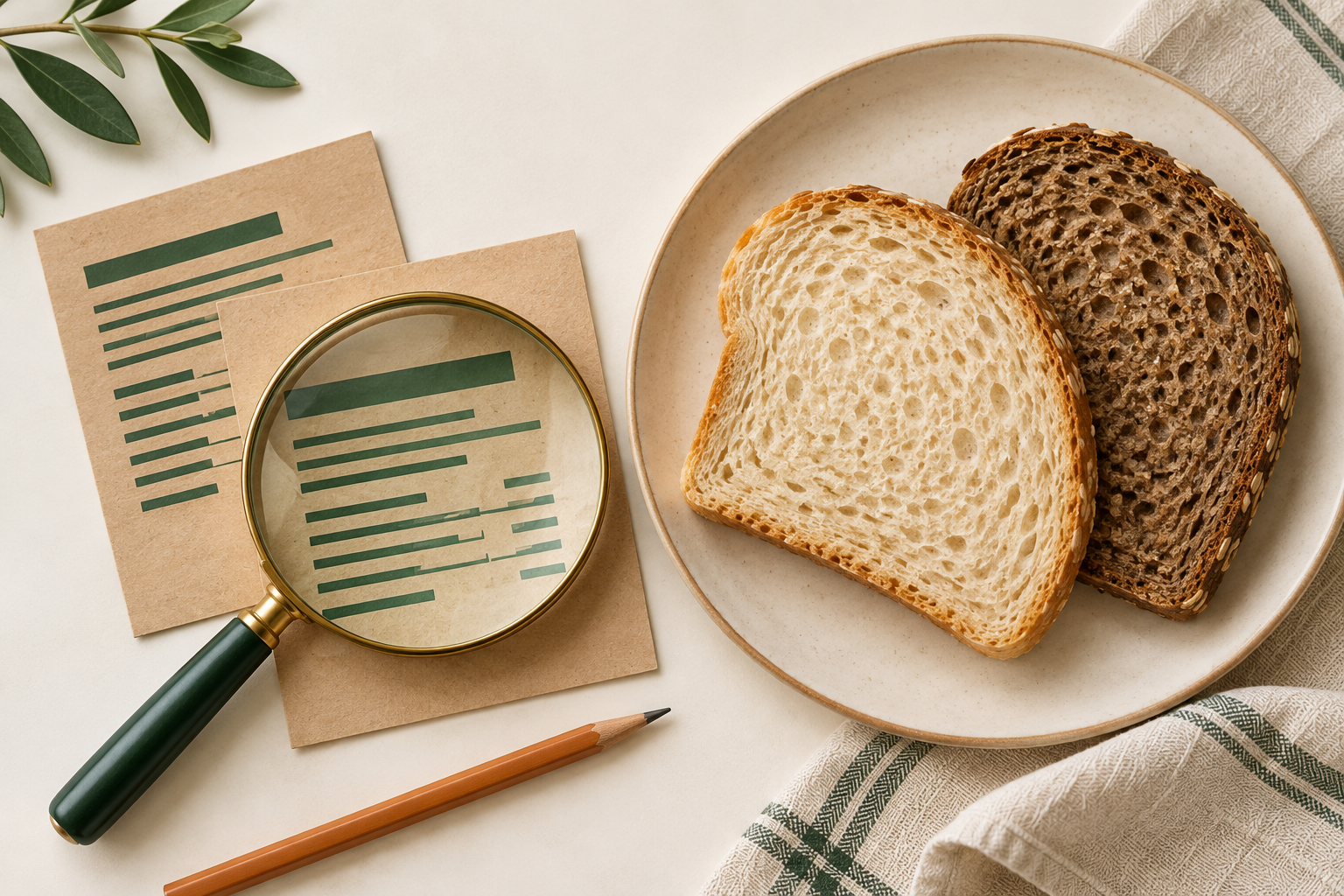
A darker slice does not establish how much whole grain it contains. The Academy of Nutrition and Dietetics notes that molasses or other ingredients can make bread brown and recommends checking the ingredient list for whole-grain wording. Its whole-grain guide explains why appearance is unreliable.
For a low-carb loaf, read the actual flour, fiber, protein, and seed ingredients rather than using color as a shortcut. Also resist the reverse assumption: a light-colored loaf is not automatically free of added colors. A package photograph can help you judge slice size and shape, but it cannot replace the ingredient list.
Caramel color: what the label cannot tell you
The phrase caramel color does not reveal which manufacturing class was used. The FDA says labels generally do not have to distinguish Class III and Class IV caramel coloring from other classes. It also explains that the term alone cannot establish whether a food contains 4-MEI, a compound associated with some caramel-color manufacturing processes. Read the FDA’s caramel-color and 4-MEI questions and answers if that is your concern.
For a shopper, the useful next step is a specific question, not an estimate based on loaf color. Ask which class the current product uses and whether the company can provide information relevant to your concern. If you simply prefer not to buy caramel-colored bread, compare an alternative that meets that preference. There is no need to turn that choice into a claim that you have measured an exposure or ranked two breads’ safety.
Colorings do not give you a separate carb calculation
Use the Nutrition Facts panel to count carbohydrates. Its numbers apply to the stated serving; the ingredient list does not give you enough information to calculate a separate carbohydrate contribution for a coloring. The FDA’s Nutrition Facts guide explains how serving size relates to the listed nutrients.
For example, suppose a label lists 11 grams of total carbohydrate per slice. Two slices contain 22 grams from the bread, before the filling. That is a made-up arithmetic example, not a product claim. Seeing caramel color elsewhere on the label is not a reason to add an invented extra amount or subtract anything from those 22 grams.
Keep any net-carb calculation separate and make clear what the brand subtracts. A color-free claim does not predict an individual’s glucose response. Our low-carb bread ingredient glossary helps you distinguish the other ingredient groups without turning their names into nutritional scores.
What about changing dye rules?
Check the current rule for the specific color rather than assuming that a news headline covers every dye. As of October 27, 2026, the FDA states that food manufacturers using FD&C Red No. 3 have until January 15, 2027 to reformulate. The agency also notes that products manufactured before the effective date may remain on the market afterward. Its Red No. 3 page gives the current details.
That date is not evidence that your bread contains Red 3, and a company’s promise to change a formula does not identify what is in the package already on a shelf. Match the current label to the exact product and ask about the lot when a transition matters to you.
A useful five-minute label check
- Identify the loaf. Note the variety, package size, and market. For an online order, enlarge a readable ingredient photograph.
- Scan for coloring names and general phrases. Read the whole list, including ingredients shown in parentheses.
- Check your actual portion. Compare the slices or grams you expect to eat, then review total carbohydrate, fiber, sodium, and other priorities.
- Separate a preference from an unanswered safety question. Choosing a color-free option is straightforward. A suspected allergy or reaction deserves advice from a qualified clinician, not a home test with the food.
- Resolve only the missing detail that affects your decision. Ask the manufacturer for the exact coloring or current label, or choose another clearly labeled loaf.
Questions worth sending to the manufacturer
Give the company the product name, UPC, and a photograph of the ingredient panel. If you already have the package, include its lot or best-by information. Then ask one focused question: “Which color additive does ‘color added’ refer to in this exact loaf?” or “Does the current formula contain the coloring I am trying to avoid?”
For a vegan preference, ask about the source rather than assuming that every certification-exempt color is plant-based. For allergy concerns, explain the specific ingredient you need to avoid; a broad “is this healthy?” question will not establish suitability. If the answer does not resolve an important concern, selecting another loaf is more useful than guessing.
Our take: buy by the label, not the shade
Choose your nonnegotiable ingredients first, then compare the bread you will actually eat. A loaf that meets your coloring preference still needs to work for your portion, allergens, budget, and everyday meals. Save a photo of a label you like, but check it again when you repurchase because formulas can change.
Want to untangle another broad label phrase? Our guide to natural flavors in low-carb bread explains a different ingredient category. Flavor wording and color wording answer different questions, so keep both in context.
Reviewed October 27, 2026. This is general U.S. label-reading information, not individualized medical advice. Illustrations are conceptual and do not depict a verified commercial formula.
Save This Post on Pinterest
Keep this label-reading guide handy for your next bread comparison. Select either graphic to save its live pin.
Plan Your Week with Our Free Meal Planner
Choose seven days of meals, adjust portions, and download your shopping list. No email signup needed.
Open the Free Planner →
