

Two breads can show the same net carbs and still produce different blood-sugar responses. The label tells you the serving size and carbohydrate breakdown, but it cannot fully describe how quickly the starch is digested, how the fiber behaves, what else you eat with the bread, or how your body responds that day.
Net carbs remain a useful screening tool. They are simply not a direct measurement of glycemic impact. A better comparison uses the complete Nutrition Facts panel, the ingredient list, the portion you actually eat, and—when medically appropriate—your own repeatable glucose observations.
Direct answer: Start with total carbohydrate and serving size, then examine fiber type, starch sources, sugar alcohols, protein, fat, and portion. If blood-sugar management is important, treat the front-of-package net-carb number as an estimate rather than a guarantee.
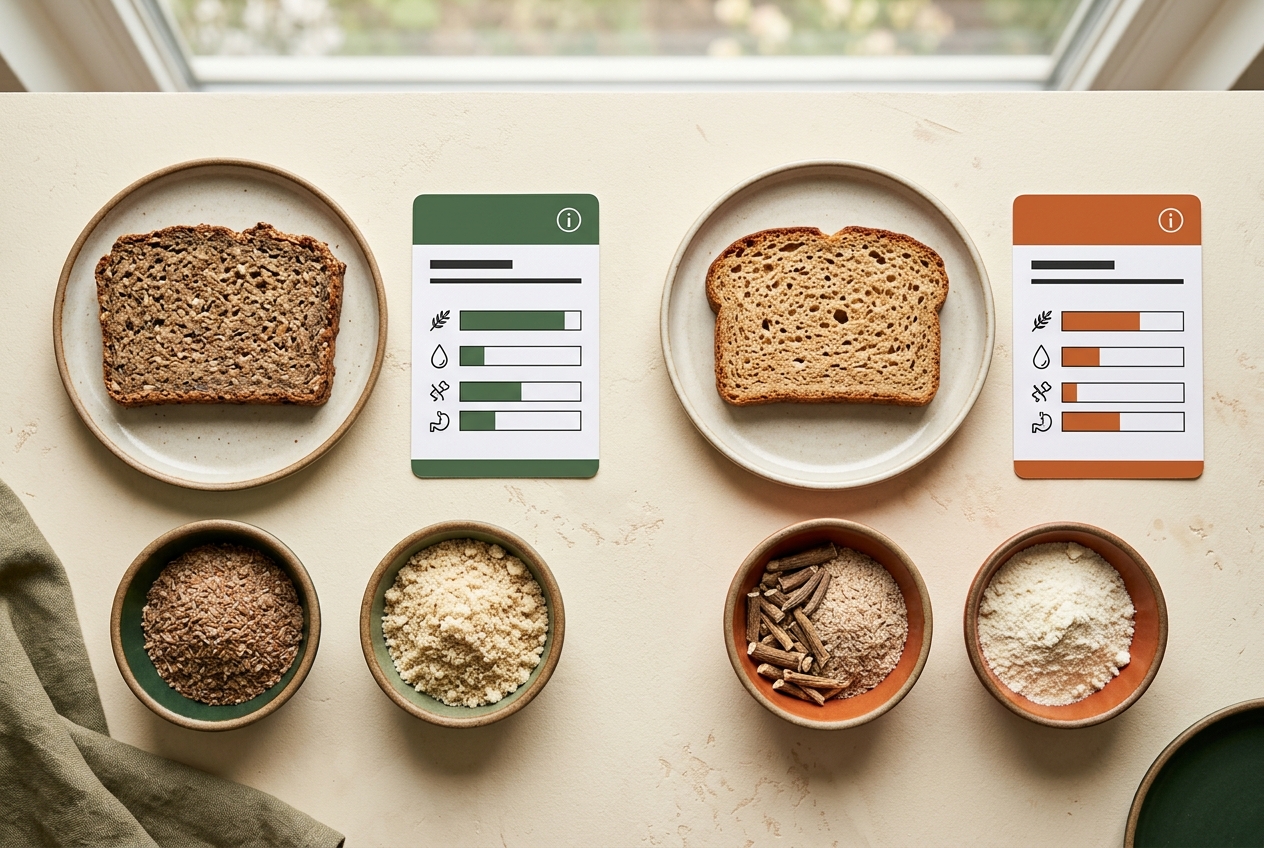
What “glycemic impact” means
Glycemic impact describes how a food affects blood glucose after eating. It is influenced by the amount of digestible carbohydrate and how quickly that carbohydrate becomes available. The term is broader than glycemic index, which is measured under standardized research conditions using a set amount of available carbohydrate.
A bread package does not show a personal post-meal glucose result. It reports nutrients per labeled serving. The FDA’s Nutrition Facts guidance emphasizes beginning with serving size because every number below it applies to that amount.
Why equal net carbs may not act the same
The starch may digest differently
Low-carb breads use many starch systems, including modified wheat starch, resistant starch, tapioca starch, and combinations of grain flours and isolated fibers. Their names and proportions matter because “starch” is not one uniform ingredient.
Human research on resistant starch has shown that replacing available carbohydrate with certain resistant starches can reduce the post-meal glucose response. That does not prove that every ingredient marketed as resistant behaves identically in every finished loaf. Processing, baking, moisture, and the rest of the formula can change the result.
Fiber is not one substance
The label combines different eligible fibers into one Dietary Fiber number. Soluble, insoluble, viscous, fermentable, and resistant fibers can serve different roles in digestion and bread structure. Our guide to soluble and insoluble fiber in low-carb bread explains those differences in more detail.
A large fiber number can lower a calculated net-carb figure, but it does not automatically predict the timing or size of a personal glucose response. It may also affect digestive comfort, especially when several isolated fibers appear in one serving.
Sugar alcohols vary
Erythritol, maltitol, sorbitol, and xylitol are grouped under the sugar-alcohol category, yet they are absorbed and metabolized differently. Maltitol can contribute more to a glucose response than erythritol. A simple subtraction that removes every gram of every polyol may therefore be too generous.
See how sugar alcohols affect blood sugar and why maltitol deserves extra attention before relying on a label with a large sugar-alcohol deduction.
Serving sizes can hide the practical portion
One loaf may list one slice while another lists two. Slice weights can also differ. Comparing “2 grams net carbs per serving” without checking grams of food may compare unequal amounts of bread.
The FDA explains that serving sizes reflect amounts people typically consume; they are not recommendations for how much to eat. If your sandwich uses two slices, calculate the bread you will actually use.
The meal changes the response
Bread is rarely eaten alone. Cheese, eggs, avocado, meat, nut butter, soup, or a sweet spread can alter the meal’s protein, fat, fiber, and total carbohydrate. Meal composition can affect the speed and pattern of post-meal glucose even when the bread itself does not change.
That makes isolated numbers hard to compare. A slice eaten alone after an overnight fast is not the same test as a sandwich eaten after a walk, with protein and vegetables, at the end of a mixed meal.
The NIDDK’s diabetes eating guidance recommends considering the whole plate, including nonstarchy vegetables, carbohydrate foods, and protein foods, rather than judging one ingredient in isolation.
A six-step label check
- Match the serving to your meal. Double the numbers when you use two slices from a one-slice serving.
- Read total carbohydrate first. This is the regulated label value that contains fiber, sugars, starches, and declared sugar alcohols.
- Identify what was subtracted. Run the brand’s net-carb math and note whether it removes fiber, sugar alcohols, or both.
- Read the ingredient list. Look for the specific starches, fibers, and sweeteners rather than relying on category totals.
- Compare equal weights when possible. Grams per slice provide useful context when slice sizes differ.
- Consider the complete meal. Add spreads, fillings, drinks, and side dishes before deciding whether the meal fits your plan.
The LessCarby label-reading guide shows where each number appears. Use the net-carb calculator for the arithmetic, then apply the ingredient and portion checks above.
Can you use glycemic index to choose bread?
Glycemic index can help describe how carbohydrate-containing foods behave under controlled conditions, but it has limits for shopping. Many specific low-carb loaves have no published glycemic-index test. A result for one formula cannot be transferred automatically to another brand or a reformulated product.
Glycemic load adds the amount of available carbohydrate in a typical portion, making it more practical than GI alone. Even so, both are population-level tools. They do not guarantee an individual response.
Using a meter or CGM more carefully
If you already monitor glucose as part of your care, a structured comparison can be more informative than a single reading. Use the same bread portion, similar toppings, similar timing, and similar activity conditions on more than one occasion. Record the starting value and the time of the meal according to your clinician’s instructions.
Sleep, stress, illness, recent exercise, medication timing, and the previous meal can all affect glucose. A different result does not necessarily mean the label is false. It may reflect normal day-to-day variation or a change elsewhere in the meal.
Medical note: Do not change insulin, diabetes medication, or carbohydrate-counting instructions based on an article or one home test. Discuss unexpected or repeated glucose responses with your healthcare professional.
What the label does tell you reliably
- The serving size and weight
- Total carbohydrate per serving
- Dietary fiber and sugars when present in reportable amounts
- Declared sugar alcohol information when required or provided
- Protein, fat, calories, and sodium
- The ingredients in descending order by weight
Those facts are valuable. The problem begins when a precise-looking net-carb badge is treated as a prediction of personal glucose. For a broader product framework, use our low-carb bread guide for people managing diabetes.
Frequently asked questions
Does low net carb mean low glycemic impact?
Not always. Low net carbs suggest less calculated digestible carbohydrate, but ingredient type, portion, preparation, meal composition, and individual response still matter.
Can a low-carb bread raise blood sugar?
Yes. Low-carb bread still contains carbohydrates, and responses vary. The size of the response depends on the loaf, the portion, the meal, and the person.
Are modified starches automatically bad?
No. “Modified” describes a processing change, not one predictable metabolic effect. Identify the ingredient, review available evidence for the specific product when it exists, and consider your measured response if you monitor glucose.
Does toasting lower a bread’s glycemic impact?
One small study of conventional white bread found that storage and toasting changed the glycemic response. That result should not be used to assign a specific reduction to every low-carb loaf. Toast for texture and preference, not as a guaranteed glucose-control technique.
What is the fastest way to compare two labels?
Compare the portion weight, total carbohydrate, fiber, sugar alcohols, and first several ingredients. Then calculate the carbohydrate in the number of slices you will actually eat.
Save This Post on Pinterest
Save either guide for the next time you compare low-carb bread labels.
A better buying decision
Use net carbs to narrow the shelf, not to end the investigation. Choose the loaf whose serving size, total carbohydrate, ingredients, fiber profile, and practical portion make sense together. If you monitor glucose, repeat comparable meals before deciding how a bread fits your routine.
This article provides general nutrition education and is not individualized medical advice.
Sources: FDA Nutrition Facts guidance; FDA serving-size guidance; randomized resistant-starch study; bread storage and toasting study; NIDDK diabetes eating guidance.
Plan Your Week with Our Free Meal Planner
Choose seven days of meals, adjust portions, and download your shopping list. No email signup needed.
Open the Free Planner →
