

Fiber is subtracted from total carbohydrate because many types of fiber are not broken down and absorbed in the small intestine the way sugars and starches are. That makes fiber less likely to have the same immediate effect on blood glucose, so low-carb eaters often remove it when estimating “net carbs.”
But “fiber doesn’t count” is a shortcut, not a literal rule. The Nutrition Facts label counts fiber inside total carbohydrate, different fibers behave differently, and the U.S. Food and Drug Administration does not require a net-carb line. The number can be useful, but it is still an estimate.
The simple net-carb calculation
Total carbohydrate − dietary fiber = estimated net carbs
Example: 12 grams total carbohydrate − 10 grams dietary fiber = 2 grams estimated net carbs. Sugar alcohols require separate judgment and are not automatically subtracted in full.
What “total carbohydrate” on the label includes
On a U.S. Nutrition Facts label, total carbohydrate includes starch, sugars, and dietary fiber. Fiber is not listed beside carbohydrate as an unrelated nutrient; it appears underneath total carbohydrate because it is part of that total.
This is why subtracting fiber does not mean removing something the manufacturer forgot to count. It means taking the labeled total and making a second calculation for a specific purpose. The FDA’s guide to the Nutrition Facts label is a useful reference for understanding that hierarchy.
The term “net carbs” is different. It is commonly used on front-of-package claims and in low-carb recipes, but it is not a mandatory line with one standardized federal calculation. Two breads can advertise similar net-carb numbers while using different fiber sources, serving sizes, or approaches to sugar alcohols.
If you want a step-by-step walkthrough of the whole panel, start with our guide to reading a nutrition label for net carbs.
| Label line | What it represents | How to use it |
|---|---|---|
| Total carbohydrate | All labeled carbohydrate in one serving | Use this as the starting number |
| Dietary fiber | Fiber included within total carbohydrate | Commonly subtracted to estimate net carbs |
| Sugar alcohol | A separate amount when it appears on the label | Check the specific type before subtracting |
| Net carbs | A calculated estimate, not a required FDA line | Use it for comparison, not as a guarantee |
Why fiber changes the carb calculation
Most digestible starches and sugars are broken into smaller molecules and absorbed in the small intestine. Many dietary fibers resist that process. Some continue to the large intestine, where gut bacteria may ferment them. Others pass through with relatively little fermentation.
That difference is the reason fiber is often separated from the carbohydrates most likely to raise blood glucose quickly. The FDA defines dietary fiber around nondigestible carbohydrates and recognizes certain isolated or synthetic fibers only when they have demonstrated beneficial physiological effects.
It also explains why “zero impact” is too strong. Fermentable fiber can produce short-chain fatty acids that the body uses for some energy. A peer-reviewed review of fiber and energy balance describes how fiber can contribute energy through fermentation, although generally less than fully digestible carbohydrate.
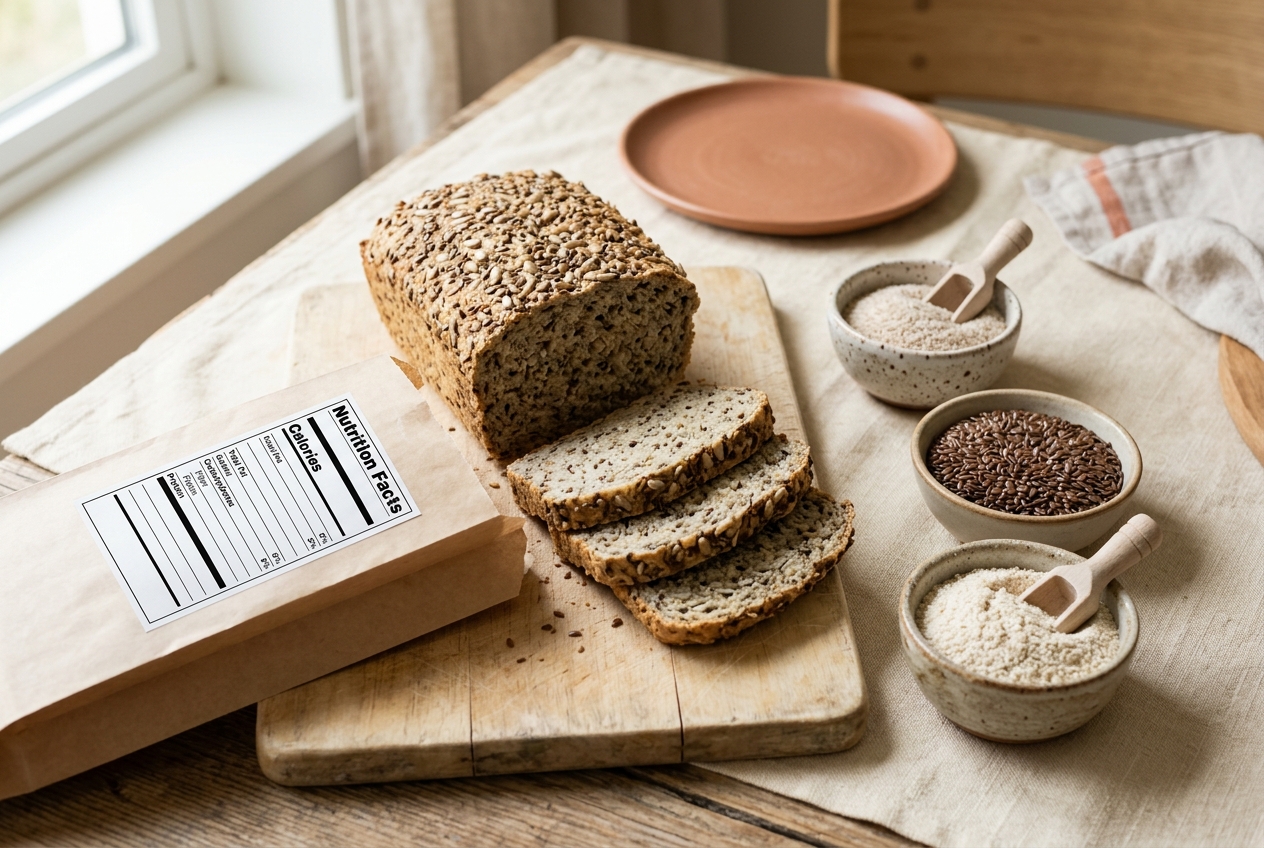
Soluble and insoluble fiber do not behave identically
Fiber is a broad category, not a single ingredient. Soluble fiber dissolves or swells in water, and some forms are readily fermented by gut bacteria. Insoluble fiber often adds bulk and tends to be less fermentable, though the line between the two is not perfect. Our guide to soluble versus insoluble fiber in low-carb bread explains the ingredient clues and practical differences.
| Fiber type | Typical behavior | Examples used in bread |
|---|---|---|
| Soluble | Dissolves or swells in water; some forms are readily fermented | Psyllium husk, inulin, and oat beta-glucan |
| Insoluble | Does not dissolve in water; often adds bulk and is less fermentable | Wheat fiber, cellulose, and oat hull fiber |
Low-carb breads may use oat fiber, wheat fiber, psyllium husk, resistant starch, inulin, modified wheat starch, or other ingredients to increase the fiber line and reduce the displayed net-carb estimate. Those ingredients can differ in texture, digestion, and tolerance. The ingredient list therefore matters alongside the headline number.
Our low-carb bread ingredients guide explains what several of these ingredients do in a loaf and why they are used.
When net-carb math can mislead you
Subtracting labeled dietary fiber is a reasonable screening tool, especially when you are comparing similar products. Problems start when the result is treated as a guarantee.
| What you see | What it tells you | What it does not prove |
|---|---|---|
| High dietary fiber | A substantial part of total carbohydrate is labeled as fiber | That the bread has zero effect on glucose or digestion |
| Very low net carbs | The manufacturer or reader subtracted certain components | That every person will respond the same way |
| “Keto-friendly” on the front | A marketing claim aimed at low-carb shoppers | A standardized FDA definition or personal fit |
The American Diabetes Association notes that the usual net-carb formula is not entirely accurate because fiber and sugar alcohols are not always completely unabsorbed. Its guidance on understanding carbohydrates recommends looking at the full label instead of relying on a front-of-package claim.
That caution matters most for people who use carbohydrate counts to manage diabetes or medication. In that situation, follow the counting method recommended by your clinician or diabetes care team. The ADA’s label-reading guidance focuses on total carbohydrate for formal carb counting.
How to evaluate a high-fiber low-carb bread
1. Confirm the serving size
A low number is only meaningful if the serving matches what you will eat. Check whether the panel covers one slice, two slices, a roll, or a smaller-than-expected portion.
2. Read total carbohydrate and dietary fiber separately
Do the subtraction yourself instead of relying only on the front label. If sugar alcohols are present, identify the specific type before subtracting anything. Maltitol, erythritol, and allulose do not behave identically.
3. Check the ingredient list
Ingredients appear in descending order by weight. Look for the main flour or starch, the source of added fiber, sweeteners, and any ingredients you know you do not tolerate well.
4. Compare more than net carbs
Protein, sodium, calories, portion size, texture, and price can all affect whether a loaf makes sense for you. A bread with one more estimated net carb may be the better choice if you enjoy it, tolerate it, and can use it consistently.
5. Pay attention to your own response
Fiber can cause gas or bloating, particularly when intake rises quickly. The National Institute of Diabetes and Digestive and Kidney Diseases explains that some carbohydrates reach the large intestine, where bacteria break them down and produce gas. If a very high-fiber bread bothers you, a smaller portion or a different fiber blend may be easier to tolerate.
For glucose concerns, personal readings and professional guidance are more useful than assuming every “1 net carb” product will behave the same way. Our bread-buying guide for people with diabetes covers additional label details to compare.
Does high fiber automatically make a bread healthy?
No. Fiber is valuable, but one favorable number does not settle the question. A useful bread also needs to fit your dietary needs, portion, budget, preferences, and tolerance. Review the whole Nutrition Facts panel and ingredient list.
The FDA’s Daily Value for dietary fiber is 28 grams on a 2,000-calorie reference diet. That can help put a serving in context, but individual needs vary. A loaf does not have to supply an enormous amount per slice to be useful, and more is not automatically better in one sitting.
Frequently asked questions
Does fiber have zero calories?
Not necessarily. Some fiber passes through with little energy contribution, while fermentable fiber can yield energy when gut bacteria break it down. It still behaves differently from fully digestible starch or sugar.
Does fiber raise blood sugar?
Fiber generally has less direct impact than digestible carbohydrate, but the complete food matters. A bread can contain fiber alongside starches, and individual responses vary. Avoid treating the fiber line as a promise of no glucose change.
Can I subtract all fiber on a keto diet?
Many people use total carbohydrate minus dietary fiber as a practical estimate. It can help compare products, but it is not a standardized guarantee that a food will fit every person’s carbohydrate target or produce a specific metabolic response.
Why do some low-carb breads have nearly as much fiber as total carbohydrate?
Manufacturers often replace part of the conventional flour or starch with fiber-rich ingredients. Because dietary fiber remains included within total carbohydrate on the label, subtracting it can produce a much smaller estimated net-carb number.
The bottom line
Fiber “doesn’t count” in net-carb math because many fibers are not digested and absorbed like sugar and starch. That shorthand is useful, but incomplete. Treat the result as an estimate, verify the serving size and ingredients, and judge the bread as a whole rather than letting a single front-label number make the decision.
New to the calculation? Read What Are Net Carbs? for a broader introduction.
Save This Post on Pinterest
This article is for general education and is not medical advice. If carbohydrate counting affects diabetes treatment or medication dosing, use the method recommended by your qualified healthcare professional.
Plan Your Week with Our Free Meal Planner
Choose seven days of meals, adjust portions, and download your shopping list. No email signup needed.
Open the Free Planner →
